Nowadays, chess training comes in all shapes and sizes. Of course you can opt for a personal approach. But it logically comes with a hefty price tag. You should count on amounts of approximately €50 per hour. This can of course be extremely useful and with such an approach there is a lot of room for questions and specific problems that the trainee is experiencing. For many, such a price tag is a bit too hefty.
A classroom approach can offer a solution for these players. I have been a member of “Killer Chess Training” for over a year and a half. The driving force behind this online chess academy is the well-known trainer and author GM Jacob Aagaard. But he is far from the only one who provides training. There is an extensive group of masters and grandmasters who provide the training.
How it works
The academy opted for zoom webinars. It means the participants can see and of course hear the trainer, but not each other. That’s really nice. My previous experiences with online training were not always a pleasure. Because if you can hear and see each other, it is distracting. The biggest disadvantage of such an open setting is, that when the trainer shows a position, there are always people who immediately start shouting all kinds of moves. It creates a chaotic environment. This means you don’t get the time to think for yourself.
Fortunately, this is different with killer chess. The participants pass on their suggestions via chat. Only the trainer sees them and then responds to them. In general, everyone will have sufficient opportunity to come up with ideas or ask questions. It provides peace of mind. Being able to think for yourself is of course more educational than a situation in which others already mention the right moves (or blunders for that matter).
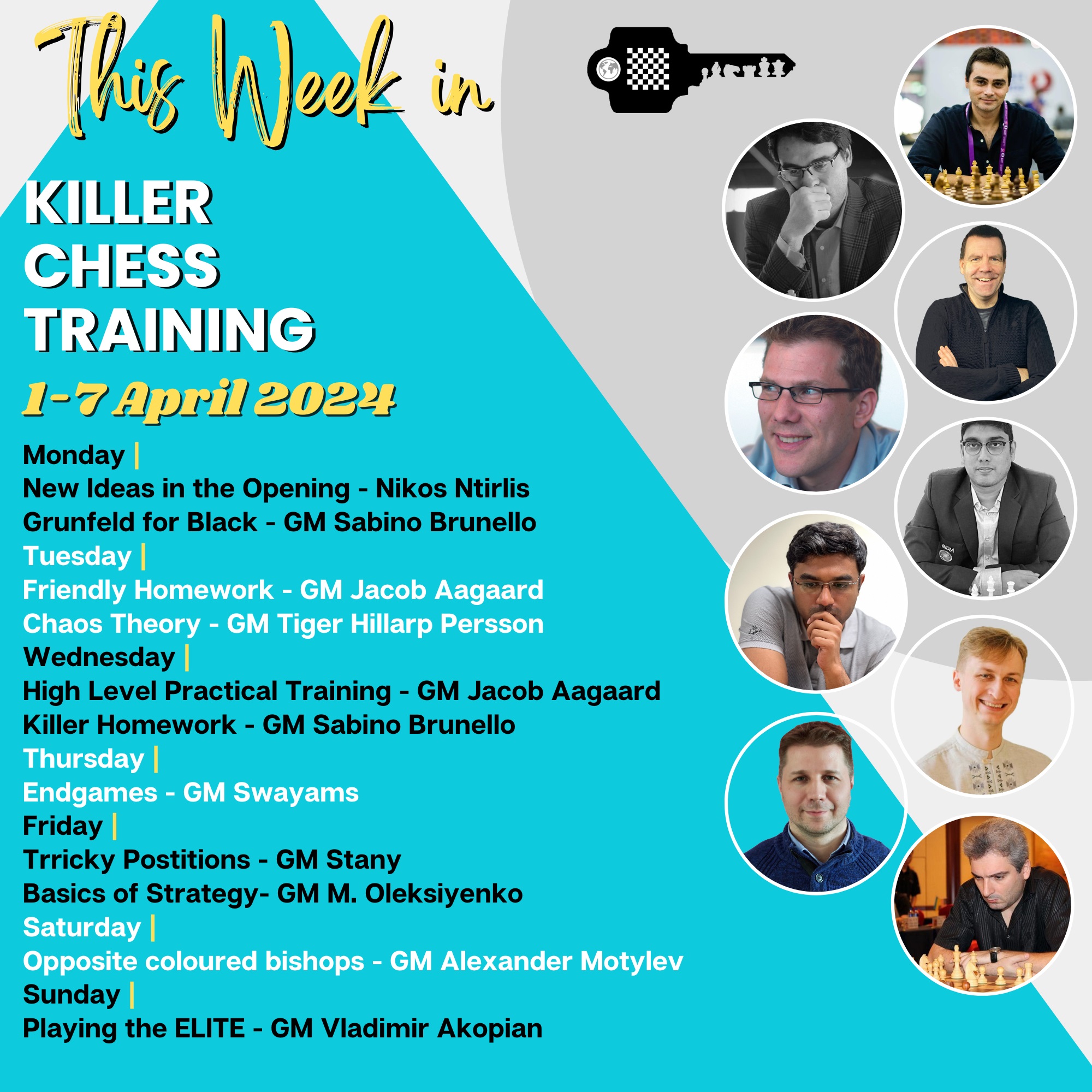
All webinars are recorded so you can watch them again later or the ones you may have missed. Killer Chess operates worldwide. So not all lessons take place at times convenient for us Europeans. Here you will find an overview of the lesson schedule. (times are UK times, so we have to add an hour). You can conclude from this that there are lessons every day. Sometimes two in one day.
What topics are discussed?
Of course, this varies a little over time. But members can count on an variety of topics, for example:
- New ideas in the opening – Nikos Nitrilis
- Killer openings: TBC – GM Sabino Brunello
- Friendly homework – IM Renier Castellanos
- Killer homework – GM Sabino Brunello
- Analyze my tournament – GM Julen Arizmendi
- Endgames II – GM Swayams
- Tricky positions – GM Stany
- Basics of strategy – GM Oleksuyenko
- High level practical training – GM Jacob Aagaard
- Playing against the elite – GM Akopian
- Finding new ideas in Spanish – GM Sam Shankland
- Chaos – GM Tiger Hillarp Persson
I will highlight two core parts of the training program: homework and analyze my tournament.
Homework
The homework assignments are an important part of the training design. The participants solve these puzzles themselves and then submit them for correction. You always get useful feedback. The friendly homework trainer, IM Renier Castellanos, then discusses all the puzzles in a webinar (about one hour). There is of course also plenty of opportunity to ask questions. There are two versions:
- The friendly version (Friendly homework) for players under 2,000.
- The deadly version (Killer Homework) for players above 2200 (players between these categories are advised to follow their feelings).
The difference, as you might expect, lies in the difficulty of the puzzles. In the past you could only submit one of the two versions. Nowadays you can submit both. Very strong players (above 2400) are advised to spend a maximum of one hour on the friendly version. The friendly version also contains plenty of problems that very strong players have difficulty with.
The friendly version consists of three parts. It starts relatively easily with 6 tactical puzzles. Most of these puzzles are not particularly difficult. Although there is always one that requires a bit more effort. This page does not count in the rating and does not provide comments for players with a rating above 1500.
On the second sheet the participant will find 6 puzzles with the emphasis on calculation. You can sense it: there are generally more or less forced variants. Correct calculation is the key. The third sheet contains 6 mixed problems. Furthermore, the participants receive no clues or hints. These are positions such as one might encounter in a game. It’s fun to give it a try yourself. You can download the PDF of friendly homework 161 here and then do the exercises yourself first. Then when you play back the recording, you can see how you scored.
If you play the recording, you will see at the beginning that there was a problem logging in. Previously, it occasionally happened that a hyperlink for logging in did not work properly. That problem was solved via the forum. In case of a problem, participants can always go there and find the correct link. Fortunately, this rarely happens. In the forum, participants can also exchange messages and obtain additional information. You will also find an example of Killer Homework 173 – 2024 03 13 The Killer version consists of a sheet with 6 calculation puzzles and a sheet with 6 mixed puzzles.
Analyze my tournament
Every Thursday evening there is a special lesson: “Analyse my tournament”. Participants can submit one or more of their own games in advance. These games are available to the other participants on Tuesday in the form of a PDF. You will find a recent example here:
The Spanish grandmaster Julen Arizmendi provides these lessons. He does this in a very clear way. The participants are given sufficient time to look at the positions themselves. It is possible to download a sheet with all the positions a couple of days prior top the lesson. In this way it is possible to study them by yourself on before hand. During te lesson there is plenty of time to come up with ideas and suggestions. These lessons lasts approximately one and a half to an hour and forty-five minutes. It is very interesting, well structured and educational. You can also see for yourself how Julen conducts these trainings through this video recording.
ChessTempo and Video
As mentioned earlier all lessons are recorded. It gives members the option to view missed lessons. I sometimes do this myself with lessons where I was present, but want to review it again at my own pace. The advantage of a video is of course that you can stop it at any time. In addition to the videos, the material is also available via ChessTempo. All participants receive a free account at ChessTempo (Gold Membership) and can study and copy the moves (in pgn) of a the lessons there. Of course ChessTempo also has a viewer.
Training camps
Separate training camps are also organized on a regular basis. These are usually three or four evenings, each with three one-hour lessons on a specific subject. Recently, GM Mykhaylo Oleksiyenko provided the training “Turbocharge your Tactics Camp”. But Jacob Aagaard, Ivan Sokolov and Sam Shankland have also organized such training camps. There is an additional fee for these camps. In this case: €149 for 12 hours of extra training. You will also get a recording with it. The annual subscription includes one training camp of your choice for free.
Investment
Everything has a price tag. It is possible to become a member for 1 month or 1 year. You invest:
- 1 month € 149
- 1 year €765 (including participation in a training camp of your choice and subscription to ChessTempo).
- See all possibilities and programs in the webshop
Conclusion
A 1 year membership at €765 seems like a lot of money, but in fact it is very cheap. The participants receive a great amount of excellent material with explanations and can of course choose which lessons they take or skip. I learned a lot from it myself. And what is perhaps even more important in my case: I enjoy it a lot almost every day. In short: highly recommended.
 Michel's Chess Blog