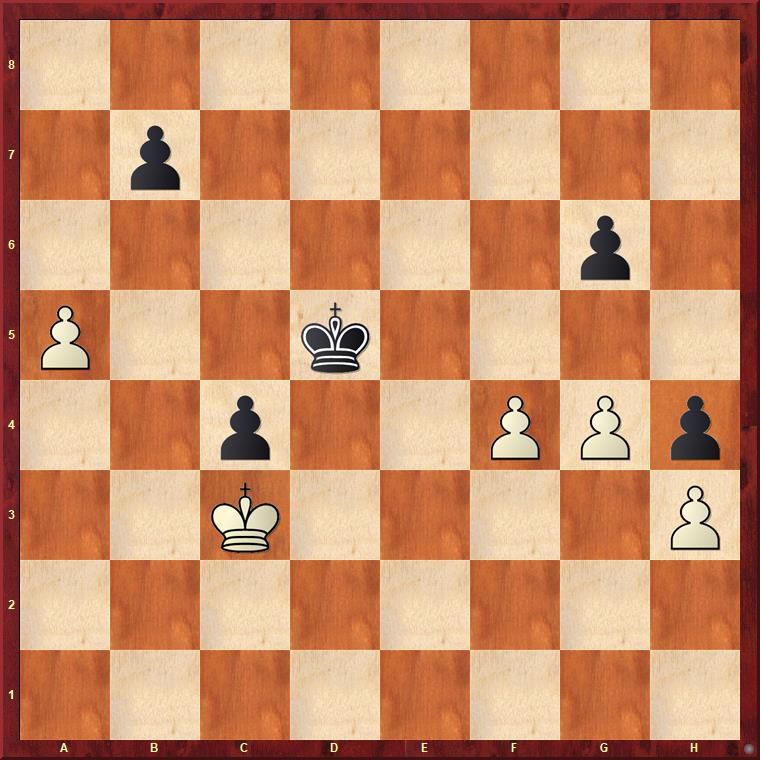
Pawn endgames often seem deceptively simple. There are only two kings on the board and a handful of pawns. If you also know something about opposition, you might think you know everything you need. Or do you? Question: what’s the best move for Black?
Scroll down for the answer.
In this case, it’s not about opposition. Pawn endgames are often a race between pawns: who can promote first – or, as in this case, to prevent your opponent from winning that race some way or another.
Black played 36… Kc5?? which is a mistake (easy to make in a blitz or rapid game). Did he think something like “I keep the opposition?”
This immediately highlights another tricky aspect of pawn endgames: you need to calculate with extreme precision. It all comes down to details. At first glance, it looks like White will queen first. And that’s true -but Black still has the final say! See the analysis at the end.
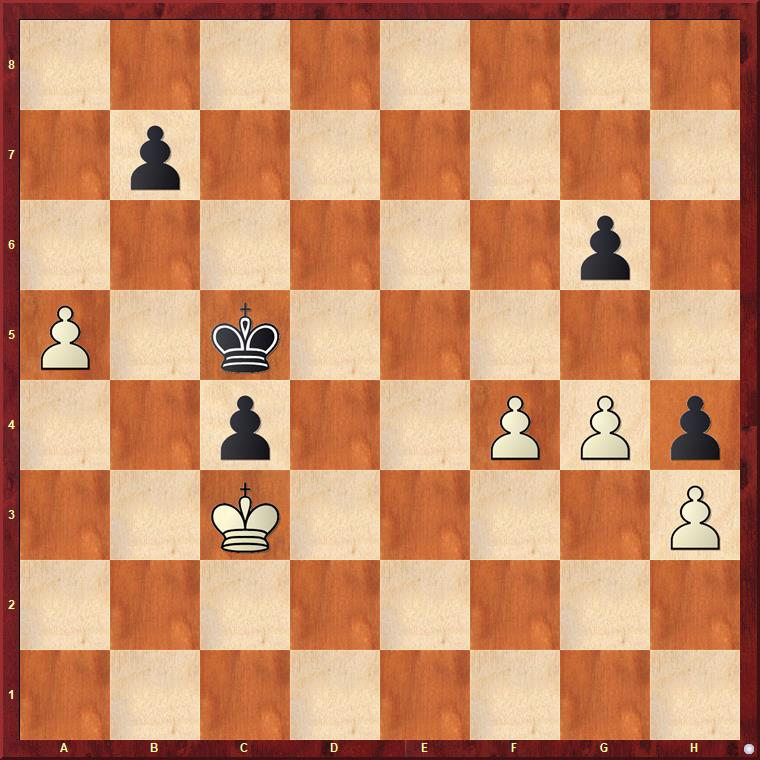
But first another question: how can White win after 36… Kc5??
Click here for the answer
This was the original puzzle on Lichess.org, rated 2187. I never quite know how to interpret these puzzle ratings, but this suggests that a fair number of players struggled with it. Now, White’s kingside pawns suddenly take over with 37. f5! The f-pawn distracts the Black king, allowing White to capture the b7-pawn and win the game. White still needs to play precisely, though – mistakes are always lurking in pawn endgames. Click here for the complete analysis…
 Michel's Chess Blog