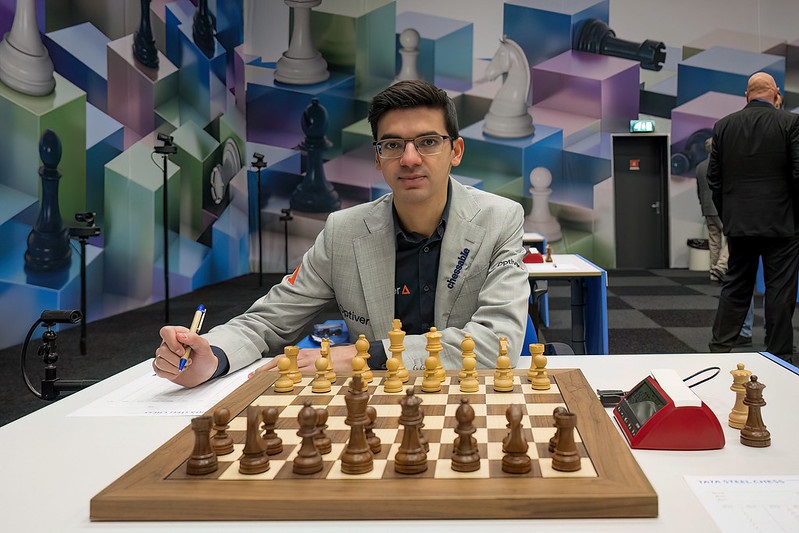
Anish Giri has had a very busy schedule over the last couple of months. He was very successful in the FIDE Grand Swiss and qualified for the Candidates. He had a shot at the World Cup, but that didn’t go as planned, like with several other top players. It’s a hard and ruthless event. In this interview, Giri talks about his experiences in both tournaments, his ideas about chess, and much more. Let’s give the floor to Anish Giri!
Could you share some of your experiences from the Grand Swiss?
For sure. It’s been a while ago, and I am still enjoying the consequences of that since I am now going to prepare for the Candidates. The freshness of the tournament has faded. The Grand Swiss was a very interesting event. I thought the format of such a strong open, where only two people qualify, is the worst format there can be for me to qualify because usually I don’t lose many games, but I don’t win as many games as some of my competitors do.
Normally, this is not my format, one would think. But I still had to try because why else would I come if you don’t want to try? I was trying to play as aggressively as I can and try to score as many wins as possible.
It was amazing that it, with a lot of luck, worked out. It was an interesting tournament because, actually, there was a lot of frustration for me during the tournament. You would think that, okay, I won many games, therefore everything must have been good. But actually, surprisingly, if you look closely, I had so many missed opportunities in that tournament. My memories of the event itself involve very mixed feelings.
Sometimes I have tournaments where everything goes amazingly well, and I am happy every day. You either save a lost position, and then you’re happy. Or, if you win from an equal position, you’re happy. In the end, you won the tournament.
But this was different because somehow I didn’t know what was happening. I was lucky. In all the games, I was getting chances, winning chances almost every day, like literally every day almost. Besides my game against Ivan Cheparinov, which was only one game in 11, I think, where I had no winning chances at all. There, the opening ended in a line which is just forced equality, so nothing happened in that game.
But in all the other games, like I think literally all the other games, so 10 games, I had serious chances, at least practical chances to win. As you can imagine, I didn’t win half of them, and I felt very frustrated with many, actually.
Against Abhimanyu Mishra, I was winning at one point. I was very annoyed when it ended in a draw. Against Frederick Svane, I was almost happy to escape, but afterwards I saw that in the final position I could have played on. He had no time, and there was a very interesting way to get the play going. I underestimated that line. In my opinion, it was a missed opportunity as well. Against Alireza Firouzja, I also missed an opportunity in the opening. It was in the penultimate round and could have been very costly. I was very frustrated after that game too.
Against Salem, I had at one point also a winning position. I guess against Parham Maghsoodloo, I was also winning at one point. There were many days where I felt frustrated at the end of the day. But maybe in some sense, it also kept me going because I had the mindset of not being content. The opposite can happen: after you win a few games, you feel okay and good about things in life, and you start to play less aggressively in the next games. In the end, you have a good tournament, but you don’t win the top two prizes and don’t qualify. In the Grand Swiss, that was not the case. There were a lot of missed opportunities, but amazingly, with the last-round win, everything worked out for me. My score was enough to finish first. I didn’t have an amazing tiebreak, so I was kind of lucky that it happened that way. Anyhow, everything worked out in the end. It was an interesting tournament with many chances for me. Probably there was something that I was doing right if I got so many chances as well.
Can you tell us something about your experiences in the World Cup?
It was very unusual because it was the only time I went to the World Cup knowing that I didn’t have to qualify for the Candidates from it. I was curious if that would make me play much better than usual. I think ultimately it didn’t work out because it made me play more free and aggressive in the classical portion, which was a good thing in the second round (Giri didn’t have to play in the first round; favorites received a bye for the first round) because I took a lot of risk in the second game and won.
It backfired in round three against Donchenko. It went wrong because I took some risk in the opening. And after I took a little bit of risk in the opening, he completely outplayed me. He played a really good game.
Usually, I can tell after the game when it was a good game or not, without having to look at the engine. It happens a couple of times a year that I lose. I just feel and I know that my opponent played really well. Before this game, it happened to me against Chithambaram Aravindh in Prague. I lost that game. Such things happen now and then. I am a good player and have a reasonably good understanding of chess, but there can be some games where, in certain positions, I just understand the position worse than my opponent. He calculates very well and I basically got outplayed in that game.
Part of it was also because if I had been more dependent on the outcome of the World Cup, I would try to play more safely from the start. That’s also risky though. I experienced it in the World Cup before this one. I played very solidly against Abbasov. We made many draws. And finally I lost one of the last Blitz games. So even if you play safely, you can still lose to an underdog. So it’s just difficult in the World Cup to get far. This one didn’t really work out for me. I was just unfortunate that Alexander Donchenko played really well, and he went on to play well in a couple of more matches. He didn’t qualify, unfortunately for him, in the end. In the end, he lost quite convincingly.
It’s just very hard in the World Cup. You lose one match and it’s over. Before both tournaments, my plan was basically to do my best in the Grand Swiss and give it a shot. Of course, I thought I would not manage, like it’s impossible to manage to win the Grand Swiss. So I didn’t even expect it at all. The World Cup was where I was hoping to qualify. It’s where I really had a chance. But it turned out to be the other way around. After losing in the World Cup, I was not very upset afterwards. But of course, I wanted to win like everybody else, and I was hopeful I would win the tournament also, but it just didn’t work out.
There were more top 10 players who didn’t go very far…?
It’s just very difficult because lower-rated players are also extremely strong. They are very sharp because they play online all the time. They play the Titled Tuesday kind of tournaments, and they prepare hard for the World Cup because this is their one shot in the year where they could erase all the past, all the things they’ve done wrong in tournaments, and overcome the misfortunes they had. This tournament is like a shortcut to go from having nothing to fighting for the world championship title. So it’s such a unique opportunity that everybody is preparing so hard. And it’s difficult; that’s why when I play in the World Cup lately, it is difficult for me to play there as well, because all the people I play there are so well prepared.
Their level is higher than usual. For instance, if I play the same player in the German Bundesliga, he is well prepared, but nothing special. If I play the same player in the World Cup, he’s far better prepared. I looked at Donchenko’s schedule before the World Cup and I suspect he spent a few weeks preparing for this tournament. Normally he spends one evening preparing for a game against me.
It seems every once in a while you have some difficulties converting a winning position. What kind of problems do you encounter in that regard?
It happens sometimes. If you look closely at my games and you don’t look at games of other people, you might get a feeling that it happens more in my games. There are a few things going on here. First of all, I think compared to players at my level on average, this isn’t my strength. So you could call it a relative weakness. That’s definitely the case. There are a few factors that make this problem worse.
On one hand, if you look only at my games and not at other players, you might get the wrong impression. Because if you look at other players – just choose any player, let’s say for instance Vincent Keymer, Fabiano Caruana, just pick any good player – you’ll notice that they also don’t win a lot of so-called “winning” positions.
So while I agree that maybe I am one of the relatively worse ones, if you look at others, it is just a very common thing in top chess that you don’t win a winning position. So that’s one thing. Now, another thing that also contributes to this problem is that there are many ways to define a winning position.
There are positions that are winning, let’s say, winning in many ways. It is obvious that any player around my level, or a little bit weaker as well, when he looks at the position, he will just say:
“This is a completely winning position.”
Sometimes, very rarely, I don’t win those either. What I usually don’t win are winning positions where there are only one or two wins or maybe only a few. There is a win, but it is a difficult line that you need to find. Only this line wins. Such lines can be very, very difficult. It means you were winning in absolute terms, but from a practical viewpoint, it isn’t so easy.
The other thing is that a lot of my winning positions are actually winning from the standpoint of the computer. Actually, from a human standpoint, they’re not yet winning. Just because the engine says plus two, it isn’t always easy to find the first five moves. After that I get somewhere. Then I still have to make 20 decent moves. Finally, I’ll be completely winning after 25 moves, and then in the end, I have to convert it. Only then it will be easy. The problem is: there are many, many ways and steps ahead to take. I fail somewhere on the way because it’s a very difficult task.
That’s one of the issues with winning positions. One more thing is that I have a very wide opening repertoire and work a lot with the chess engine. A lot of advantages I get in my games are based on what the computer says. I go into an area where my opponent is vulnerable and I get the advantage thanks to the computer. But at some point I have to start playing on my own, of course. It’s much harder to convert this advantage that was built up with the computer than the one that some other player builds up from the start by himself.
Another player more often has a situation where he goes into the game and, after the preparation (shallow or none at all), he gets an equal position. After this, he slowly builds up advantages that he understands, and then he gets a big advantage, but that advantage is his own. He has built it up and he understands why it’s there. And basically, he started as if he had a plan from A to Z. He knows how to proceed. While I get to that same point very often, not through knowing exactly what I have done, but through computer-assisted preparation. So then these advantages, they are not really fully mine and I don’t fully understand them. This is also a reason why that can be happening. On one hand, I am, of course, not amazing at converting winning positions, but the other thing is that a lot of my winning positions and winning advantages, they’re very hard to find.
Take for example my game against Maghsoodloo. I was better from some point onwards. Then he gave me one small chance where I have one exact way to win, which I didn’t find. I found the second-best solution. Again, I am better for a bunch of moves. He defended well; the game ended in a draw. I had only one brief moment where I was winning. So you could say I missed a win in this game, but it was not that I was winning the entire time.
The situation was similar with Mishra. There was one short moment when I was winning. Also with Salem, there was just one brief moment. It was not that I have built up a winning position. The definition of the word winning position is very important to understand. So I am not so bad at converting actually winning positions. It is just that a lot of what people think are winning positions are winning according to the computer. From a human point of view, it is very hard to do so.
Another reason I get many of these positions is that I am a very intuitive player as well. So very often I feel I can build up a winning advantage without seeing why it’s winning. It just feels right. After you build up these advantages by intuition, in the end I have to find the computer sequence. I am not good at finding computer sequences that I don’t know. This isn’t my strength.
Some people are better at it. Arjun Erigaisi is much better at finding computer sequences, or Gukesh and Caruana. On the other hand, I do get more winning positions than most people. Take for instance the Grand Swiss. I probably had like eight winning positions out of 11.
The computer can be very tricky for humans. To really analyze how good or bad I am at winning positions, we have to do very detailed analysis and try to see every single game, which win I missed, and how it was. I do understand that if you are a fan of mine and you follow my games with an engine and you mainly follow my games and hardly other people’s games, you might get a feeling that I am bad at converting winning positions. I also get that feeling for myself.
Nowadays there are a lot of youngsters who play very good chess. What do you think about it?
It’s not new; it was always like this in chess. When I was little, I beat number one Magnus Carlsen at the age of 16. I was also a Grandmaster at 14. That was relatively early. Bobby Fischer was a Grandmaster early as well (in 1958 at the age of 15); that was almost 70 years ago. But it’s not completely new for chess, but nowadays it is much easier and much faster to learn chess. The engines got so much stronger. There are more books, (video) courses, video lectures, and coaching got much better.
The Indian youngsters joined an academy that was organized by Vishy Anand. They got coaching from Gajewski and many other players. These people were coaches of Vishy Anand himself. So if you get, from a teenage age, coaching by someone who has experience working at World Championship matches, you get a head start. It is sort of cutting corners. Imagine you are faced with a problem and are looking for a solution. Before, to find one piece of information, I needed one week digging through a lot of rubbish to find the correct piece of information. They get that one piece of information in half an hour. That one week of digging that I did was not a complete waste of time. I still became a decent player.
Thanks to the engine, coaching is much better than before, because coaches also have better access to the tools. Coaches can understand positions better thanks to the engine and then explain it also better to their students. Learning goes a lot faster.
There is also better knowledge. Take for instance basic endgame knowledge. There are a lot of children that know the basics. I remember watching at some point in the World Rapid Championship. Almost all the games were finished, except a game on one of the last boards. It was a Rook + Bishop against Rook. You think these are weaker players. But a young child defended this endgame in the best way possible. He did it very confidently and fast.
Twenty years ago, that wasn’t happening. Now they have clear knowledge of what is the best way to defend. They know the endgames you need to know and, of course, which endgames you don’t need to know. In my time, these things were not as clear-cut. The entire process of learning chess has become more systematized and less chaotic.
When I learned all these endgames, I learned in one training session how to mate a King with Knight and Bishop. In another training session, I learned some Rook plus Bishop thing. And in another session, I learned some Rook endgame, and so on. It was a bit sporadic and it took me many years. Now there is much better clarity for coaching and for players. If you are now a 10-year-old 2400 player, you already know all of these basic things. You know exactly how to mate with Knight and Bishop against a lone King, or the Rook against a Bishop. These kids know all the basic Rook endgames you need to know. It goes very efficiently. The same applies for opening and other knowledge.
So they learn the basics much faster and they reach a very high level fast. But then once they are there, there is still some difficulty remaining. When they do get very high, they are going to encounter problems. One problem is that everybody else had the same access to the same tools, so they also got very good. There is more competition, and then it is still a question: how do you differentiate yourself? How do you become a world champion? How do you qualify for the Candidates? All these problems will remain for these children as well. But the initial step of getting to a very high level has become much easier, for sure.
What do you consider your greatest strength?
(Starts a long think) I don’t think there is one thing that I do better than everyone. Let’s say if you compare me to Carlsen. I think Carlsen does almost everything better than me, apart from just a few things. I am a little more tactically sharp than Carlsen. I fall less for tricks by opponents than Carlsen. I am more in sync with the computer than Carlsen, because I work much more with the computer myself. Carlsen relies more on his seconds. The synchronization between me and my computer preparation is a little better. It means that I can go to certain positions which Carlsen usually avoids. I am worse than Carlsen at everything else. That being said, compared to most players at the top, I have a better positional understanding than them, which is still inferior to Carlsen, but is better than a lot of other players.
I do have a reasonable combination of skills, but it is not just one single thing. It depends on who you compare it with. Compared to the modern top 10, I think I have a very good positional understanding. But it’s inferior to Carlsen. Maybe I am in some areas inferior to Aronian or older experienced players. In some areas maybe inferior to Caruana and maybe to Nepomniachtchi. On average, I have a very good positional understanding and a very good opening preparation. Again, not like the best, but it is up there, and there are only few players who have something comparable. It’s probably Caruana and maybe Arjun Erigaisi and Praggnanandhaa.
I am a good defender in certain types of positions. But many players nowadays are good defenders. It is actually not easy to say. That is why I am not world number one, because I don’t currently have one clear strength where I am much ahead of others. All in all, I have a very good skill set.
For example, when I played Carlsen, just combining my computer preparation and the fact that I blunder less, gave me a lot of points against him. I have beaten him in two classical games because of his blunders. I have survived many games against him because of my preparation. As long as for every player that I play, I can find an area where I am better than him, I’ll be fine. This is what I feel. I feel that basically whichever player you compare me with, there are some areas of the game where I am better than that player. That is enough for me, but I don’t have one thing that I am better at than the rest of the chess players, which is why I am probably not as high as I would hope.
Looking ahead. I saw a press release for Tata Steel Chess. Half of the players who go to the Candidates are playing in Wijk aan Zee. What’s your feeling about that?
The Tata Steel lineup is extremely strong. It has always been this way. I am not surprised anymore at this point. I expected this would happen. We have a great field at the tournament, and half of the players are or could be Candidates. Arjun Erigaisi could have qualified and Vincent Keymer could have qualified. It is a stellar field.
There is one thing we should accept at this point and conclude that it seems that Carlsen is no longer playing the tournament. As far as I can remember, he promised at some point in a video that he would be back next year. But he skipped that one and he didn’t come back. It says more about where Carlsen’s chess is at this moment than about the tournament. It isn’t that he isn’t invited or there is no budget for him. It seems that Carlsen no longer wants to play and he is taking a step back from classical chess. If Carlsen doesn’t play now, we should accept that times are changing. He still plays some tournaments, maybe Norway Chess. I don’t know what will be the format. He plays so little now that unfortunately, he is no longer part of the group of players that competes for classical chess.
What are your feelings and expectations about the upcoming Candidates Tournament?
I am really looking forward to this event, to do my preparation and to give it a shot. It would be really amazing if I were to succeed, of course. But none of the eight players who qualified is favorite to win this tournament. Were that to happen to me, it would be truly amazing. So I’ll do everything I can to try, and I’m looking forward to preparing for the tournament. I have a fair chance if you look at recent trends and the score between the players. I am doing fine in that sense. What is also interesting is that Hikaru Nakamura has a very good score against the field. He has a very high rating. He is the first seed by rating. But he is, of course, highly inactive in classical chess. I would definitely not list him as a favorite. Maybe there is something to his barely active rating, maybe he is worth that rating. I don’t know. We will see.
Fabiano is probably the greatest player after Carlsen of this entire generation. I love competing with him. I never admit to myself that I am a worse player than Fabiano. I truly don’t think I am weaker than Fabiano. You can call me delusional. I do have to say that we have played top chess for so many years now, and he has proven with his results that he is far more accomplished than me in all regards. He had an incredible chess career, and he is the second-best player of the generation after Carlsen, by far. And of course, in every cycle, he is the man to beat. If Carlsen quits, then immediately everybody looks to Fabiano.
It’s not how life works and it’s not so simple. Whenever I play Fabiano, I don’t feel worried or scared. I have a very good score against him. I mean, more or less equal. That is good for me. Or maybe I won one more game against him over the years. We had many good fighting games. It is not going to be easy for him to win the Candidates.
There is also Praggnanandhaa. He was in good form at the beginning of the year. Now he has slowed down a bit. I don’t know if he can regain the momentum again. The other players are all very good, but you wouldn’t list them as favorites.
We have a favorite on paper, which is Nakamura. We have a favorite in terms of career accomplishments with Caruana. In reality, you know how it is, Gukesh won the Candidates last time. The way it works, anybody can win. If Caruana or Nakamura don’t win, nobody will be surprised at all. The tournament is wide open.
Fabiano, for example, is amazingly prepared always. But every time it gets harder and harder to be better prepared than others. I am very curious how Fabiano wants once again to be better prepared than everybody else. I don’t see how that’s possible, because the computer has equalized everyone. Getting superiority in the opening is going to be hard. It makes the field even. No matter how hard you prepare, the opening preparation isn’t going to make any difference. In the end, it’s going to be a pure fight. Anything can happen. There are eight great players, so I don’t think my chances are amazing.
Does playing in the Candidates bring more tension?
Yeah, for sure. You can tell from the games, [and] the mistakes people make. There is a lot of tension. It’s much harder to play the Candidates than to play any other tournament. I have also played in a few Candidates. My level was worse there than in other tournaments. It’s just very difficult.
How do you prepare for a Candidates tournament compared to other tournaments?
You have much more time to devote to it. You focus on it more. For normal tournaments, you first make a schedule of tournaments you play. Then you ask yourself: how much time is left for this tournament? And basically, I would say that for no tournament other than the Candidates or a Championship Match do you do so much work.
The question is: do you start preparing before finishing the last tournament before that? Maybe for Wijk aan Zee I might do that. That is why I play well in Wijk aan Zee very often because I do a little bit of prep for this tournament. Mostly, people never do that. They usually prepare for the next tournament. Because everybody’s schedule is busy, you almost never prepare or think about an event for more than a month. The Candidates is different. There are still several tournaments in between, but since I know I play the Candidates, I am already preparing for it. I spend just much more time thinking and preparing for it.
This question is in line with the last question and about mental resilience. How do you prepare for it?
I think a lot of it is your own experience. I don’t think you can prepare for it. It is just who you are; a lot of it is how you are built, what kind of person you are. Let me put it like this: when you are a player who isn’t prepared for the mental resilience of the Candidates, I don’t think there is something you can do in two months to fix it. It is too late.
One can improve. I have prepared for many events now and I am quite knowledgeable. I have worked with psychologists and read some books about the mental aspects of different sports. I have listened to interviews of great players, followed lectures, and I think I am knowledgeable enough. But it isn’t about knowledge; it is about applying it.
Some people know in theory exactly what to do and how to do it. They know when the tension gets too high they have to take five deep breaths and their heart rate will go down. They take five deep breaths, but the heart rate doesn’t go low enough. It doesn’t work for them. They know the theory, but they are just not built for it. There are certain things you can’t just compensate with knowledge. I am an experienced player and have played many events, so I think I am good enough in that aspect to compete.
Do seconds give you some sort of emotional support during the tournament?
The thing about being a second of someone who is present at the tournament is that even if you don’t want to impact the psychology, the mentality, or the emotional support, you cannot avoid impacting it if you are there. Even a remote second still may contribute. Whoever is joining the tournament with you is going to impact you psychologically. It can be positively or negatively. What usually happens is that sometimes the impact is positive and sometimes negative. Coaches, when they are with me, definitely play a big role in the mental support, for sure, whether they want it or not. It just happens.
Some players are very nervous and trembling while playing. These things are just the physiology, probably inborn, of a person; it is very hard to change. One can definitely impact it when they work on it, but it’s a very slow, long process.
What do you consider your best game?
In terms of results, the fact that I beat Magnus Carlsen in two classical games. These games, in terms of sporting achievements, are my best achievements. I beat Carlsen and Ding Liren in that same tournament. Carlsen was, of course, World Champion, and Ding won the title in that same year. Tata Steel 2023 was probably my best tournament so far in terms of sporting achievement.
From a creative point of view, well, I don’t keep good track of it. I had many nice games. I think from a creative point of view I played some nice games in the B-Group (2010 – the tournament was then called Corus) in Wijk aan Zee. Somehow it was an amazing tournament for me. I don’t know what happened, but I played some of my nicest games there. Particularly there was one against Tommy Nyback, which was very beautiful.
I played some pretty attacking games. I remember a game against Laznicka which was nice. I had an attack with Black against Ding Liren in our match in Wenzhou (2017).
I am a result-oriented chess player and never choose a move just because it’s prettier than another move. I could have played more beautiful games than I did. A lot of times when I have a choice to do something just beautiful, I only do so if it improves my chances to win. Because of this particular stylistic thing, I don’t have as many beautiful games as some other players who are famous in chess history, like Michail Tal.
But I have a few nice games. If you dig through my games, you can find them. A lot of my nice games were in 2008, 2009, and 2010 when I was young. I played some nice games in the Benoni, for instance against Nyzhnyk.
From a purely artistic point of view, the beauty of chess, I am not the best player in that regard because I am choosing the move which I think is the most efficient. It means when there is a move which is boring and it is winning for sure [it will be] a win, and the other one is only 80% a win, but could be beautiful and amazing and spectacular, I am going to go with the boring move always. I try to have the best results. This is how I believe you should play chess professionally. It is the reason why I don’t keep track of my beautiful games.
How do you see your own future in the chess world?
I don’t need to see that far ahead. I am at the age where the most rewarding thing to do is to focus on professional chess, [and to] accomplish as much as I can as an active player at this age. I am obviously doing other things, first of all, to prepare for the next stages, but also to make sure that right now I don’t have distractions and limitations and that I can pursue certain projects. I have sponsorships and obligations which allow me to play completely free and not have to worry, for example, about finances. That’s very important because if you have to worry about finances every game and every tournament, you’re not able to play free. That’s why I do many things, but right now my focus is fully on professional chess. This is the age where I should be doing that. I am trying to do things which are right. It’s very tempting, for example, to retire and say, you know,
“I won Wijk aan Zee and it’s difficult to become World Champion; you have to be very lucky. Why bother? It’s very stressful. Instead, just quit everything and enjoy life. Maybe I can make more money as well if I just concentrate on how to invest properly. I might make more money than with chess. If you invest the money I earned with chess in some really smart way, it will probably be better for me financially!”
But I am not prioritizing my financial status or a relaxed life. At my age, it’s too early to do that. I am and have been a professional chess player. I always tried to become World Champion, and right now I have a duty to myself, at my age, where I am more or less at my peak. Even if I am a year or two past the biological peak, it would be a crime against my career to slow down right now. Therefore, I will go fully for the professional chess, and we will see what happens after I will be past my physiological peak. Probably within 10 years’ time, I might do the same like everybody else: first switch to rapid and blitz. I will say that classical chess is dead (says this with a lot of irony) and gradually move towards other things. For now, I should really give it a shot.
 Michel's Chess Blog