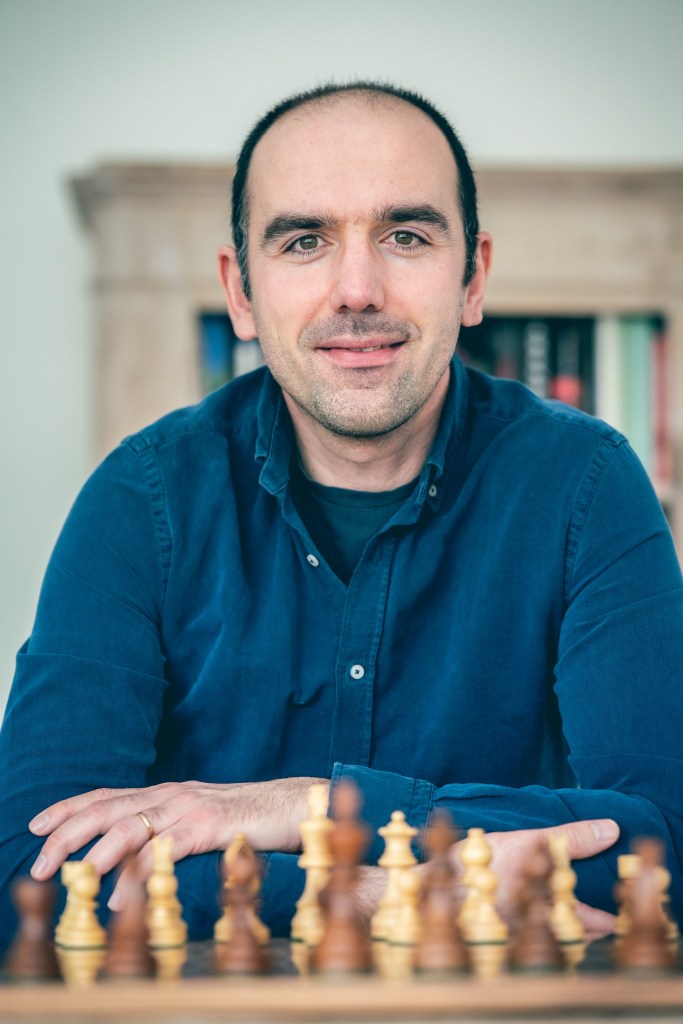
Can is a Candidate Master and FIDE Instructor based in Sweden. If you’re active on Chessable or YouTube, his name likely rings a bell. As one of Chessable’s most popular authors, you might even own one of his courses.
His track record speaks for itself: he won the 2022 Community Author of the Year Award, his course Fundamental Chess Calculation Skills was voted Best Tactics Course of 2023, and he was crowned Chessable’s Author of the Year in 2024. Need I say more? Let’s dive in and see what this remarkable coach—with his unique chess background—has to share about coaching, training, Chessable and much more.”
From your biography on Chessable, I gather that you started playing chess relatively late. What triggered your interest, when did you begin and who taught you?
My cousin taught me when I was eight. She attended a private college in Istanbul where they offered chess lessons, but my school didn’t. So, one summer, she taught me the rules and I became interested in the game. I remember finding the game absolutely fascinating when she explained it to me. I played a little against my grandfather, but those were just casual games; nothing serious at all. I still remember some of the games we played in his old place in Ankara. Sadly, he died when I was 11.
Later, around the age of 15 or 16 in secondary school, we played against friends during breaks. A couple of people brought chess sets and we would play. It was still very casual, but competitive. Around the age of 17, I got my first book: Capablanca’s Chess Fundamentals. My grandmother bought it for me. I started reading chess books and became more serious about the game, though I still wasn’t playing in any tournaments.
The reason? There is a entrance exam for university in Turkey when you’re 18. You prepare for about three years in high school, as it determines your future. Therefore, I hardly had time for chess because my entire focus was on getting good results. After I entered university, I decided to take a gap year during my prep year. I took English lessons to improve my language skills and pursued things that interested me.
Around the age of 18 or 19, I immersed myself in chess and bought many books. However, I still didn’t play in tournaments and had no Elo rating. There were casual tournaments in Ankara, but things were becoming serious as I started playing online on ICC and other platforms. I remember analyzing games from greats like Botvinnik and Tal, and studying the Zurich 1953 tournament. Of course, there were also Kasparov’s books. I became a total chess nerd, spending four or five hours a day immersing myself in books.
I got my first Elo rating when I was 21. That was my first serious tournament, in Istanbul. My initial rating was 2153, which is highly unusual. Nowadays, as a coach myself, I rarely see such stories. I had no idea what my level was when I entered that tournament. I had been working hard and playing a lot online, but I had no expectations whatsoever—which might have been a good thing. There was no stress, even though I played against very strong players and, funnily enough, did well.
I feel a deep passion for the game; I immersed myself in it for its own sake. It wasn’t necessarily about becoming a FIDE Master. Of course, I wanted to improve, but that wasn’t the main reason for all the work. The game simply fascinates me. Think about the clashes between world champions like Tal, Botvinnik, Karpov, and Kasparov. Even when I created my first YouTube channel in 2007, I analyzed games by Fischer, Spassky, and other World Champions. The microphone quality was terrible and my English was poor, but I was very happy with those analyses.”
You have made a remarkable progress in a short amount of time. How did you manage that?
It’s like I said before: just a deep immersion in the game – playing correspondence chess, analyzing games and reading annotations of the masters deeply. And pure passion, interest and motivation to get better at the game. That was the biggest predictor to my mind.
Your first inspiration was Capablanca?
Indeed, I even played the Caro-Kann because of Capablanca. Then came Fischer and Kasparov. After that, I started playing the Najdorf because of their influence.
What was your best result so far in any tournament?
Back in Turkey, it was around 2006 or 2008, when I first got my Elo rating, I started playing in some tournaments. I also played for the university team. Our team had never qualified for the first division in Turkey until then, so we were the first ones to achieve it. We did it by qualifying through the second division. It was at a summer tournament in Konya (Turkey). We played against different teams for one week. I played on board four; teams consisted of six players. I scored 7,5 out of 9 points and won the gold medal for my board. It was quite a big achievement, especially in terms of what I contributed to the team. We qualified for the first division and I played for the first division the next year, but I didn’t do as well.
After I moved to Sweden, I performed well in a couple of tournaments in Lund. In Lund, there were some weekend tournaments and others where you play once a week – they’re called them “autumn tournaments.” You play once a week for eight or nine weeks. I won a couple of those as well. But off the top of my head, I think that result in Turkey was the best.
After I finished my PhD Cognitive sciences and became a doctor, I had more free time again, I worked hard on chess and became a candidate master. I gained about 70 Elo points. For me it was quite a big achievement, because I wasn’t expecting that to happen at my age – I was about 32, and I had been immersed in my PhD for four or five years. I didn’t have much time for chess then. After that period, I had more time for training and playing chess.
My memorable game is against Swedish IM Axel Ornstein in 2019. I have recorded a video about this on YouTube, so you’ll see
I was very satisfied with the game. He was much stronger in his youth. He won the Swedish Championship seven times and played against players like Boris Spassky. But in 2020 he was of course not as strong as his prime years, but it was a beautiful game on my part and I was very proud of it.
How did you get into coaching?
One can never predict what happens in life. Life is full of surprises and uncertainties. If you had asked me five or ten years ago if I would end up in a place like this, I would probably have said no. What I knew about myself was that I liked teaching. But there wasn’t much opportunity to teach often in my university position during my PhD years. It was 100% research-based – you just had to work with different species, like ravens and so on. I felt something was missing, because I really enjoyed teachting.
During the COVID period, I started to think about whether it would be useful to start something else – call it a sort of “plan B”. Taking the opportunity, maybe, to try something that I’am passionate about and might have some talent for. It just so happened that during COVID, when everybody was stuck at home and getting into chess (The Queen’s Gambit and so on), I thought:
“Why not give some chess lessons to people in the weekends or evenings?”
At that time, there was a website called coachess.com – it’s no longer there now. I saw that any coach could register and people can find you. That’s how it started, somewhere in 2020. I even remember one day I was playing too much online chess. It became too much and I needed a break. It crossed my mind:
“I need to do something else with this game!”
I love the game, but I can’t spend all my time just playing. I thought maybe I could give new life to my YouTube channel while giving some lessons. Let’s try that. That’s how it started. I started giving lessons to a few people and they loved it.
Everything came together: my passion for teaching combined with my passion for chess. I love to help people and see their feedback and improvement. The cycle was born from there. What also helped was word of mouth; that way I got more viewers.
Then the Chessable competition started in the summer of 2021. It was called “Create Your Own Competition” on Chessable. Again, totally randomly, I saw it one day and said:
“Okay, I already have some material at my disposal from giving lessons to my students. Why don’t I just compile this material and apply for this competition?”
That’s how my first course, “The art of exchanging pieces”, was created. Chessable liked it and published it. At that time nobody knew me, and small group of people bought the course. But they liked it and told others about it. That lead to more students over time. A beautiful cycle between Youtube and Chessable was born.
The basis for my teaching lies in working with people; that’s what sets my courses apart. They were born out from practical experience with players from different levels. I saw their struggles through my coaching, and that led to my courses on Chessable, which in turn brought me more students. After that, the ball just kept rolling. By the way, I still give lessons – these days, they are mainly group lessons. I don’t want to coaching because it keeps me grounded regarding people’s struggles and their everyday problems with chess. It’s very important because it gives me direct feedback.
You graduated in cognitive sciences and earned a PhD. What was your area of research? Can you elaborate on the connection between cognitive science and you work as a success coach. How do they influence each other?
The last part is the most important part of the question. I was a biologist from the start, but I was also interested in psychology and philosophy. When I needed to find a PhD program, I ended up in a lab within a Cognitive Science program. It involves many fields, like animal cognition, robotics, philosophy and linguistics. Cognitive science is an umbrella term; in general you want to understand how the mind works. There are different approaches or stances to it, and you use all this information to gain a better understanding of the mind. One side looks at animals because of evolutionary questions – to put it shortly: trying to explain how the mind evolved and why it evolved like this way for humans.
My background in Cognitive Science means that I am very interested in how the mind works. It’s about questions around how we process information, memory and how learning takes place. That has consequences for any kind of expertise, including chess. When I became a chess coach, I became much more interested in these subjects and the preconditions for chess learning – especially for beginners and adult improvers. It’s different from learning the game as a child. The learning processes are different for adults.
I’ve also talked with Fernand Gobet about these ideas. Fernand Gobet is a professor and an International Master from Switzerland who lives in the UK. He has done so much work on chess, expertise, and memory; he even worked with Nobel laureates. He’s definitely the number one person when it comes to the connection between cognitive science and chess.
He’s a very busy man and is purely in academia rather than being a coach himself, but I’ve talked to him about certain projects we could apply for. For example: what are the best teaching methods for chess improvement? Surprisingly, nobody has done a study on this yet. Even though every coach will tell you a certain method works for them, there is no scientific comparison of different techniques when it comes to the objectively best improvement outcomes.
That was one of the ideas we could have worked on together, but we both got busy and didn’t apply for the project. It would also probably take a long time to conduct. It’s not an easy project; it requires many people, control groups, and different tasks. For example, one group focusing on tactics while another group focuses on openings.
You need to be very diligent with a study like that. But the ideas are “in the air”. So, what I do is look at the literature and reads lots of books on learning and cognitive science. I use that to structure of my YouTube lessons and Chessable courses – to “scaffold” them and make it easier for people to absorb the material. One thing we know from Cognitive Science is the limitation of working memory. Working memory is our bottleneck. If you overload it with too much complex information, no learning taking place. People immediately get overwhelmed, especially beginners.
Sometimes strong players overestimate how much beginners can learn. They can easily get overwhelmed with new information if you don’t break it down to its core elements. We have to make sure that the information that we give to students is not too complex for their level. The best predictor of learning is the student’s current level, their previous knowledge and so on.
You have to make sure to give the information in digestible. That’s the reason why I created my course “The Chess Elevator” on Chessable. I looked at games from different levels starting all the way from 600 Elo to 1200 Elo. I was just looking at the games and trying to find out what kind of mistakes were happening – and which kind of mistakes were no longer happening at the very next level. If you know that a skill is attainable at the next level, but isn’t quite there yet a slightly lower level, you can design exercises that are most beneficial for that specific group. We know that the level just above them can solve these problems more or less.
Imagine giving Dvoretsky’s Endgame Manual to a 900 Elo player. They will get overwhelmed and no learning takes place. Coaches need to make sure that what they teach is relatable to the students level. That’s how that course was born. It got great feedback; every single day I hear from people improving their rating by 100 points or 200 points, sometimes even within a couple of months after finishing the course.
I am using the best practices from different fields, despite the fact that nobody has done this exact kind of scientific study on this specific question yet. When it comes to YouTube videos, I show them some simple positions first and then gradually increase the difficulty. At least, I’m trying my best to structure it like that. Because if you understand something in a simpler form, it’s easier to build upon. But if you start too complex, they get overwhelmed.
Chess is such a complex game. There are so many pieces on the board and beginner’s mind can get overwhelmed easily. That’s why they are miss the “sniper bishops”- attacks from long-range enemy pieces lurking on the other side of the board. They don’t see the bishop, usually a fianchettoed bishop, because they are so focused on a particular segment of the board. They suffer from tunnel vision. Tunnel vision happens all the time for beginners because they aren’t yet able to encode the entire chessboard as a single chunk.
The question is: how do we structure the learning material to help beginners as much as possible? It’s similar to things like CLAMP (a checklist to prevent blunders: Checks, Loose pieces, Alignment, Mobility restrictions, Passed pawns). Before you make a move ask yourself at least what the opponent wants to play on the next turn. It’s pretty basic stuff, but not for beginners. That’s why I am doing my best to break the material down to its core to make it relatable for people. I’m still not perfect by the way – I’m still reading every single day and learning new things.
How much time do you spend on chess coaching each week and where and how do you conduct your session?
I used to give more individual lessons, but now I limit myself to group lessons on the weekends – one group on Saturday and one group on Sunday. Each group has four to five people from different levels. The first group consists of people with a rating between 1,000 and 1,200 (Chess.com rapid level), and the other one is about 1,600 to 1,800.
It’s a tricky thing to put those groups together because people need to along well. I also need to like the group dynamic, and we need to be able to talk about things. Sometimes we digress and talk about different topics. Running these group lessons is an art form in itself. I’ve been doing it for four years now, and of course, I’ve gained a lot of experience over the years. If there are more than, six to seven students, it becomes more like a lecture and feels like too much. But with four or five, it is manageable and everyone benefits – they also learn from each other’s feedback. That’s one of the advantages of group lessons. We meet online.
When did you realize you’re good at coaching? In other words, what qualities define a good trainer?
It’s important to find a connection with the student – liking what you do, wanting to help them, and understanding their struggles. You have to understand where they’re coming from and deeply analyze their games to find those “teachable moments”. There are recurrent patterns that, if addressed, will give the student the most benefit. It’s not just about a random moment in the game where the engine suggests a better move. Finding out what truly matters is an art form. I’ve talked with Dan Heissman about this, and he said:
“Not every mistake is of the same quality. Some moments are more teachable than others. It’s about filling important gaps in knowledge that can transfer to wildly different positions.”
The role of a coach is to find those gaps or recurring mistake patterns that, once fixed, can yield great results across many different positions. It could be a thought-process mistake – for instance, not looking at the threat of the opponent’s last move – or a strategic misunderstanding of the IQP (Isolated Queen’s Pawn). Of course, the “why” questions are the most important. Right now, Stockfish or Chat GPT don’t answer “why” questions perfectly; that level of qualitative feedback is missing still in AI.
That’s where we can make a difference for our students. This deep analysis of their games and following up on specific types of mistakes is what made a difference for me personally. In my Excel sheet, I always write down what happened during a session. If a certain type of mistake occurs, I take a note and keep track of it over the following weeks or months. I always check back with the student to see if they’ve improved in that area. We can’t expect perfection, of course – some mistakes aren’t fixed in a single week.
But if you have data on their mistakes and those numbers are trending downward, that’s great sign. Then I can target those issues with my specific courses. If somebody is struggling with a certain task, a particular course might help them.
What students usually tell me is that I’m relatable, easy to talk to, and able to identify and follow up on gaps in their knowledge. I can break down complex concepts and understand their struggles. It’s also about accountability. When students work with a coach, they feel are more responsible because someone is checking in on them. The support makes them more disciplined in their workt.
Is there a chess trainer who has served as a role model for you? If so, who and why?
I never consciously thought about this actually – maybe I should. I was a “book nerd”, so I read books from many different authors over the years. I generally like Jacob Aagaard’s books; some beginners might find them too complex, but I very much enjoy his style.
I also like Dan Heisman’s The Improving Chess Thinker. That book is relatable for many people because Dan talks about mistakes in thought process. He has worked with so many people and truly understands their struggles; you can really see that in his writing.
Jeremy Sillman was also great author; I enjoyed his explanations of concepts and how he made them relatable. Those three authors come to mind, but there are many others, like Under the Surface (by Jan Markos). During the COVID period I also watched a lot of YouTube videos.
You focus primarily on adults. Why?
It just happened to be that way. During COVID, many people were stuck at their home and searching for chess coaches. They found my lessons and told others about them. In that way my “persona” was created as the guy who helps adults, simply because most of my students were adults to start with. It led to my Chessable courses, which spoke to the stakes of adult improvement. There’s also the “ChessPunks” community on Twitter, which is mostly comprised of adult improvers; I posting there from time to time to get feedback.
I haven’t worked with many children yet; that’s something missing from my CV. Maybe at some point it will happen. Since I teach mostly online, I don’t see many kids. If I were going to a club in Sweden, probably, like the Limhamn Chess Club, I would probably give more lessons to children.
What motivated you to start with a YouTube channel?
Initially 2007, it was out of pure joy for the game, and YouTube was very new. I was actually one of the early chess YouTubers – a pioneer, you would say. Once I moved to Sweden for my master’s studies, I stopped the channel. I only “reawakened” it about two and a half years ago. Chessable was getting bigger and there was more interest in my courses.
In this day and age, you need to show your face more often on different platforms like Instagram or Twitter. I wasn’t on any of those before. I thought YouTube is a good fit because I can talk about deep concepts and demonstrate my expertise and teaching style. It also allows me to practice talking to the camera and structuring my lessons every week. This is important for my courses too, as it helps me get better at creating them. It is a “multipurpose move”: I grow my following and my courses improve at the same time. That was the main motivation behind the “YouTube Awakening.”
I still struggle a bit with the concept of Chessable. For some courses, I like it, and for other courses, I don’t. What is your take on it?
I actually made one video about this with the Chessable “super user” named Banner. He knows all the functionalities and “gadgets” of the platform that most people aren’t even aware of it. In that episode, he explained to me every single functionality and gadget of Chessable. You can tweak, how you can tweak and customize many things.
Chessable originally was born out of opening preparation – or rather, opening memorization based on the spaced repetition concept. When you learn something, you tend to forget the information very quickly. Why? Most likely it wasn’t deeply processed in our brain to start with. Spaced repetition is a great tool, but if the information is already deeply processed – using “deep encoding” in cognitive science terms – you don’t even need that many repetitions to remember it.
Spaced repetition implies that something is constantly “leaking” or wasn’t properly processed. If a concept is deeply connected to your existing knowledge, you don’t need as much repetition to keep it in your brain. That’s a key finding from cognitive science: the quality of the encoding is vital. If you blindly memorize opening moves, you’ll need constant repetition to keep them in your brain. That said, spaced repetition is still a good policy because we naturally lose irrelevant information.
Chessable’s “Move Trainer” implements this nicely. It shows you positions just before forgetting takes place, which leads to much longer retention. It’s how the brain functions, apparently. They nicely implement that part on Chessable. That’s still one of their main strengths. It’s called “Move Trainer”. It remembers your mistakes, and even if your answers to the puzzles are correct, the move trainer still gives you those puzzles, but with longer time intervals.
Move trainer is a very good gadget. But besides that, there’s also video content, which is very helpful, because you can connect the video to Move Trainer directly and vice versa. You can go to any place in a video and from there you can directly go to the position and vice versa. In that way there is cross-modal learning.
If you can explain a certain move to yourself and deeply process that information, you can refer back to that note rather than just relying on the teacher’s notes. This helps you avoid getting overwhelmed by the “ocean of information.”
However, you need to be mindful about which courses you take. In actual games, deviations happen early on, and statistically, you might never reach a specific deep line from a database. That’s why I include final puzzle chapters in my courses with four different difficulty levels to maintain a “desirable difficulty.” If positions are too complex, you get overwhelmed. Desirable difficulty means you are stretched outside of your comfort zone, but you should still be successful about 70% of the time. That is the “sweet spot” for the best learning outcomes.
Can you explain to me why people should buy your Chessable trainings? What makes them different from others?
I have a hard time “selling” myself. What should I say? Just read the course reviews on Chessable – that gives a basic gist of what set my courses apart. The best judges are the students, and there are many of them right now
I hope not to sound too cocky, I would say it is about being mindful of the best educational psychology principles: relating to my students, knowing their struggles from working with them for the last five years, and having a huge passion for teaching and chess. I am very mindful of the “whys.”
My courses are born from real struggles My courses are born from real struggles. I focus on how to get the best learning outcomes for a specific level—giving students exactly what they need. I look for gaps in the literature. I don’t mean random, complicated gaps, but gaps that are hugely important, like blunder prevention or recognizing the opponent’s last move. To me, it was a big surprise that there weren’t enough courses or books on these two vital thought processes. Without them, you simply can’t play a solid game; you have to fix those thought-process mistakes first.
My calculation course was born from my quest to give students something manageable. That’s why there are only 3-ply calculations in my course. Deeper calculations are often irrelevant because most mistakes happen very early on, and most people can’t visualize ten moves ahead. People just deviate; they can’t visualize everything with crystal clear clarity. But if you’re accurate at 3-ply calculations – if you do all the steps right in that context – then you can build on that. The course was designed to provide the pillars of chess calculation in a manageable 3-ply format. I think that’s why it won the “Best Tactics Course of the Year” award in 2023.
What’s your idea about the future of chess coaching?
I’m a little bit scared of AI, of course – ChatGPT and all the bots that are getting better and better. Right now, they still aren’t fully at our level in terms of giving “why” feedback and connecting deeply with the students.
They’re improving, though. If you ask ChatGPT, it will probably give you a realistic training plan that could work for your level. AI gives you what it has gathered from the internet. But I believe we can still make a difference as humans by connecting more deeply with people through our discussions and explanations. I hope I’ll keep my job in the future!
But having said that, things are changing so fast that it’s hard to predict if it will always stay like this. Many companies are likely working on “cracking the code” to create an AI chess coach that is always with you – one that replaces a human coach by analyzing your games and giving you feedback, basically doing what I do in my regular coaching sessions.
The question is: can it completely replace us, or will we stay relevant? I don’t know. I love my job and I love connecting with people. I love creating material for them that is relatable and helps the improve their game. I hope we remain in the future, but it’s just so hard to predict.
Correct pronounciation Can?
 Michel's Chess Blog