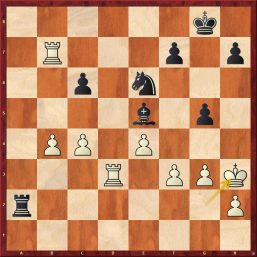
 White played 35. Kh3?? This was a bad mistake. The game would have been more or less equal after 35. Kf1 or Kh1. Do you see why 35. Kh3 was the losing move?
In other words: how does black finish the game? Solution…
White played 35. Kh3?? This was a bad mistake. The game would have been more or less equal after 35. Kf1 or Kh1. Do you see why 35. Kh3 was the losing move?
In other words: how does black finish the game? Solution…
 Off course there are general principles that apply to endgames. But mere intuition brings you most of the time nowhere. You have to calculate very careful.
See this, seemingly simple rook endgame. If it was black to move, he would have a very easy draw. See for example this variation…
But it is white to move. That makes all the difference in the world. But how? That’s maybe not so easy to spot. Do you see how white can win? Solution…
Some moments after I finished this post, I surfed to chess.com. Chess.com shows every day a new puzzle. Sometimes these puzzles are quite hard to solve. This one is also a bit tricky. See the second diagram.
 It is white to play and win. The first move is obvious. But then it gets a bit tricky. Do you see how to solve this one? Solution…
Goes without saying that not all rook endings end in a draw!
 This a position after white’s 25th move. It is from one of my own games. At our level we make (too) many mistakes. But it doesn’t mean that there are no interesting moments.
It is clear that black is much better. The white king is not safe and his pawns are weak. Compare both rooks and queens and it becomes clear that black has a winning advantage. But the situation is still a bit tricky and black can go astray very easy. What is the best move for black?
 This is a neat one. Maybe not too difficult. Black just played 1. – Rh5 and attacked the white queen.
Do you see the winning move for white? (Solution)
 Even after a quick look you will see that this position is totally crazy. White has a material advantage, but most of his pieces are en prise.
What makes matters even more complicated is the pawn on b2 that is about to queen and give mate.
Is there a way out of this mess? Can white achieve the impossible and even win this position?
Yes, he can. It is up to you to figure this one out. Solution…
If found this fantastic puzzle on Johan Salomon’s twitter account. Johan is the present Norwegian Champion and is well on his way to become a grandmaster. You will find more intriguing puzzles on his account.
 I found this one on chessbase. It is a bit drafty around both kings. But it is white to move. Therefore: white plays and wins. How? (solution)
PS. A couple of days after I posted this puzzle, I added some variations to the solution.
 The purpose of chess is of course to mate the enemy king. There is nothing more fascinating than an all out attack on the enemy king.
But how many times does this happen in our games? Maybe not so many times as we would hope for. At least that’s my personal experience.
One should develop an eye for it. Some help might be very useful. Strange enough there aren’t many books written about this subject. One such book is ‘Mating the Castled king’ by GM Danny Gormally. This book is solely dedicated to attacking the enemy king, in the place where the monarch thinks he is safe, when castled. One of the main themes in this book is pattern recognition. Danny writes:
“Chess players should have the ability to remember and recognize patterns and themes that repeatedly occur in practice. The more examples we see, the more ingrained these patterns will become until eventually they are second nature.”
Indeed when you recognize certain motifs the good moves almost automatically pop up in our minds. See for instance the first diagram. Can you see how white can obtain a winning advantage? Please think for a while before you read on.Read More »
 At first glance it seems black is in time to defend his king. White still found a way to destroy black’s defenses. Do you see how he did it? Solution…
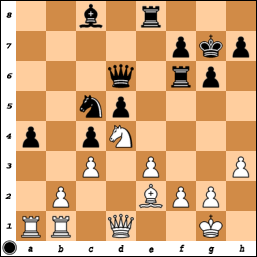 I have to confess that sometimes I spend quite a lot of time at chess puzzles. I can’t stand it when I am unable to find the correct solution.
When I make a mistake, which happens still too often, I can get very annoyed with myself.
Most of these mistakes occur when I find the solution rather quickly. Then get overconfident and don’t check very well and make stupid blunders on the second or third move in the combination. On the other hand, when I can’t find the correct solution, I keep on trying.
I follow my hunch and calculate the variations over and over again. That doesn’t work either (of course). One might raise the question: do you trust your own calculation yes or no? Seemingly not.Read More »
 I found this one from the chessbase website (first round report by Albert Silver). This position is from the game between Sam Shankland (USA) and Joan Fernandez Lopez (Andorra) after black’s last move 15. – Qb6? White can get a winning position. But how?
The obvious 16. b5 doesn’t work. What will? It took me a while to figure this one out, and of course I didn’t see all the variations. But at least I found the wining move. 🙂 Solution…
 Michel's Chess Blog