Endgame: rook versus pawn

Winning an endgame with a rook against a lone pawn should be straightforward. But sometimes things are not so easy. These endgames can get a lot more complicated when the pawn is close to promotion.

Even more problems might arise when the pieces of the stronger side are in the wrong places.

When both problems occur in the same position, the ‘stronger’ side might be dead lost. See the first diagram. This position was posted by international chess master Johan Salomon from Norway on his twitter account. It is white to play and win. Solution…Read More »

Sacrifices in the Kings Indian

Simon Williams is one of the best (if not the best) trainers on PlayChess. His shows are always very entertaining and I learn a lot from them. Simon has a knack for the attack on the king.  

Tonight he showed some great Nakamura games. The diagram is one of the positions we looked at. This was not from a Nakamura game but Simon showed it to us because it was relevant for what was to follow.

There are some neat tactics involved. The position is quite complicated. As usual in the Kings Indian white attacks on the Queen side and black tries to force matters on the Kings side.

Question: who is better?

  • White or black?
  • What would you play as white?

Hint: there are several games in the database. It was black who won most of the times, but not always! Solution…

Tricky endgame

In the foreword of his excellent book ‘Recognizing your opponent’s resources’ the author, Mark Dvoretsky’ writes:

‘Your opponent also has a right to exist – Savielly Tartakower remarked with his characteristic irony. Absorbed in our own thoughts, we sometimes forget this, for which we have to pay dearly.

As Viktor Korchnoi wrote, Well, if you do not check what your opponent is doing, you will end up complaining about bad luck after every game.’

Korchnoi’s statement is the reason why I stopped ‘wishing my opponent luck’. It implies that I wish myself to blunder. I hate making big mistakes! Nowadays I wish them a nice game and think ‘I hope my game will just be a bit more nice then yours!’

It’s great advice to take your opponent’s resources into account. It will net you a lot of extra points. We allways have to take care and ask ourselves:

‘Are there any threats’ and ‘What if I do…. how might my opponent react?’

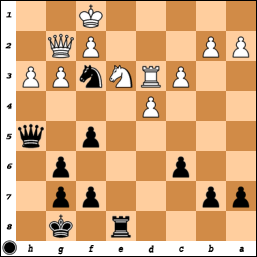
Even the simplest positions sometimes hide unexpected tactical tricks. See the diagram*. At first glance it seems that white is completely winning. He simply queens his pawn (c7xb8Q) and will be a queen and a rook up. Also taking with the rook on b8 gives white more then enough material to win the game.

Or is this a bit too cheerful? Well see for yourself. White to play and win (yes, he has a win)! But it is no so easy as it looks. Solution…

*Source: Chessbites.com

Chess puzzle #31: comeback kid gets crushed

Former world champion Boris Spassky was completely outmaneuvered in his game against Anatoly Karpov in Montreal (1979). See the diagram.

Black just played 38 … b5? This is a mistake after white can finish the game with a bang. What is the winning move in this position?

After you clicked on the link you will find the complete game. It is a fine positional achievement and a model game on the subject ‘how to play against the isolated queen pawn’. Spassky was nick named ‘the comeback kid’. But here there was no coming back. Spassky was rendered completely helpless against white’s clever play.

Chess puzzle #30: Viktor the Terrible gets crushed

The Benkö (Volga) Gambit is a rare guest at grandmaster level. But on club level it is a populair opening. Black gets a lot of pressure for his pawn and his position almost plays itself whereas white has to be constant on his guard.

The problem for white is that it is difficult to develop his pieces in a harmonious way. These are the reasons why this gambit is so popular among club players.

On grandmaster level this opening is a less frequent guest because it’s not considered to be completely sound. Grandmasters mainly use the Benkö as a surprise weapon. Grandmaster Vladimir Baklan won games with this gambit against Artur Yusupov, Sergey Volkov and Viktor Korchnoi!

Although Viktor Korchnoi was clearly past his prime in 2000, he still was a very strong player. But even he had trouble to fight the Benkö. After 17 moves the combatants reached the diagram position. Viktor has just played 17. Nf4-g2. What on earth could be wrong with this move?Read More »

Chess puzzle #35: only move to win

Last weekend I played in the Malmö Open. I was pleased with my result. The strange thing is that I scored most of my points out of very difficult situations. In three games I was objectively lost. But tenacious defence saved the day for me.

The diagram position is not one of these games. Although I had to defend myself again. White attacked fiercely and finally invested a piece in order to keep the attack going. But to no avail. I gained the upper hand.

See the diagram position after 22. Bb6. White came with one more problematic move. Black is winning, but he has to find the (only) correct move. Do you see it? I did and went on to win the game! Solution…

Wish you luck?

This August I played a tournament in the Göteborg chess week. For me it was ages ago since I played a single Round Robin with nine other combatants.

There were a lot of ups and downs. In the end I shared third price with some others. Maybe not bad for a start, but I was not happy with the qualitiy of my play (or better to say ‘the lack off quality’). Far form it. 

One thing strikes me as odd. Before the start of the game it is of course normal to shake your opponents hands. Most of them said ‘I wish you luck!’ Luck? Wasn’t it Viktor Korchnoi who once wrote:Read More »