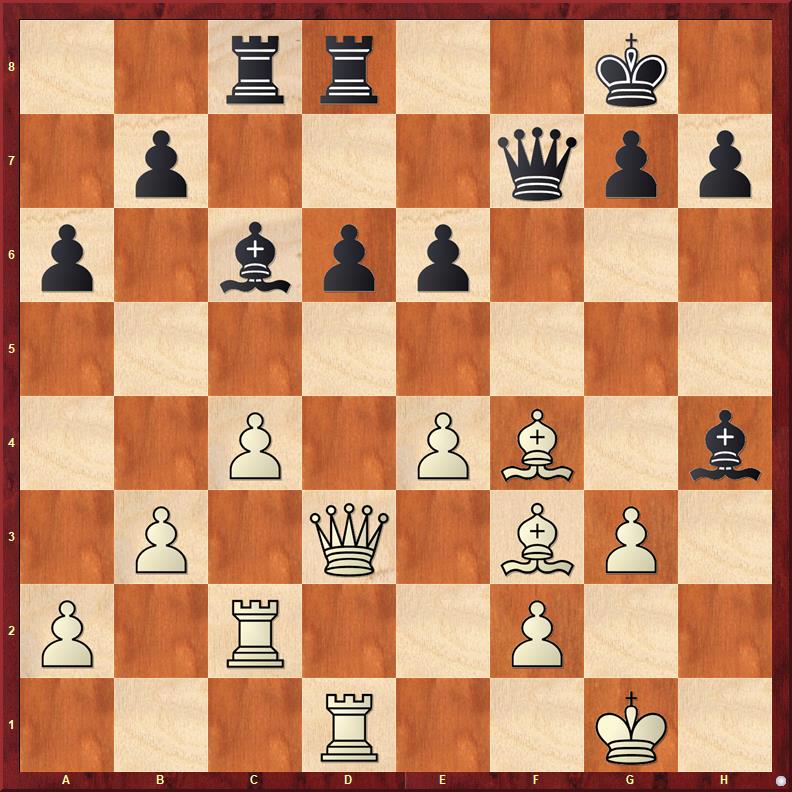
This is the position after Black’s 22nd move in a game between Stanislaw Praczukowski (2160) and Minas Mikinas (1951) Graz (2024). The question is: can White capture the pawn on d6?
You may be asking yourself: “Michel, how did you come up with this game?” Because both chess players are not well known. This game was part of a lesson by GM Julen Arizmendi at Killer Chess Training. Julen teaches the weekly lesson “Analyse Your Tournament”. Members of Killer Chess can submit their own games, which Julen will then analyze together with the trainees. Julen is an excellent chess trainer and extremely clear in his explanations. His English is also perfect by the way. Not surprising when you consider that he was born in the US.
Back to the game
First of all: capturing the bishop on h4 would be wrong. Black then captures the bishop on f4 and the h-pawn will be his next victim. The white king position is seriously damaged. But if we look at the position superficially, there seems to be no objection to taking on d6. Because:
23. Bxd6 Rxd6 24. Qxd6 Qxf3 25. Qxe6+ Kf8 26. Qxc8+ Kf7 27. Qf5+
It ends in disaster for Black. But of course it’s not that simple. What does white play after:
23. Bxd6 Be7
Then White cannot defend the bishop with:
24. e5?
Because black simply plays:
24. …Bxf3
And black wins a piece. But white has better. He can defend the bishop with:
24. c5.
Pawn won and no problem. Julen drew our attention to an important rule attributed to Mark Dvoretsky. This rule urges you to ask the question:
Before I start passively defending myself, is there anything I can attack?
Then take a look at the next position (after 24. c5).
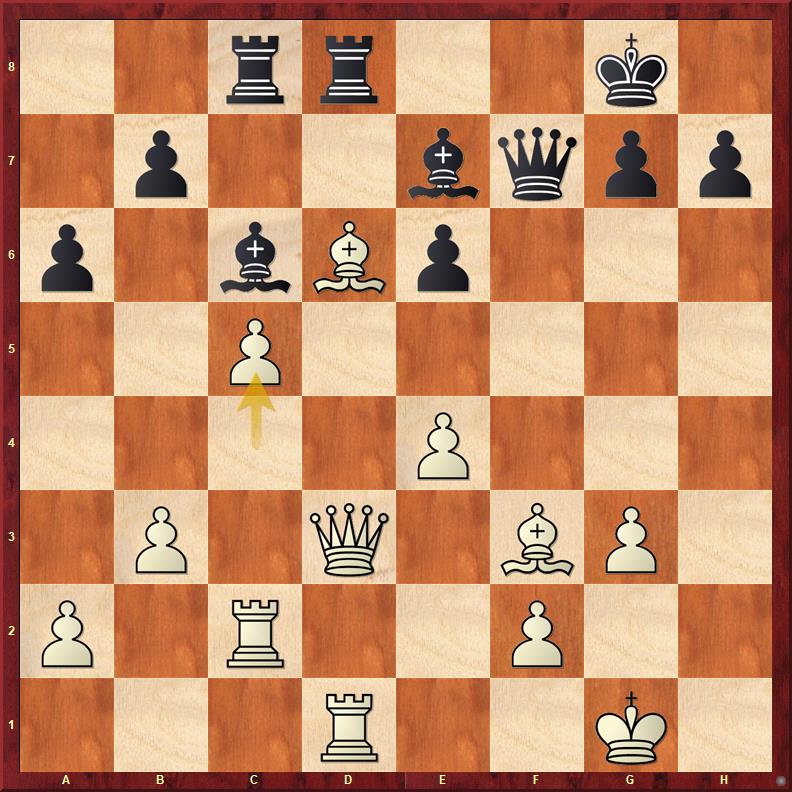
Your response will be:
“Well, if you ask it like that, it is quite obvious that Black can play 24. … Bb5!”
Indeed after:
24. …Bb5
It shows how vulnerable White’s position is. There is a nasty pin over the c-file and the white queen is overloaded. The queen must defend the bishop on f3 and also guard the rook on c2. That’s a bit too much of a good thing. There could follow:
25. De3 Bxd6 26. a4 Be8 27. cxd6 Rxc2
In short: taking on d6 is wrong.
What we can learn?
Before you make defensive (passive) moves, first check whether you can attack something and therefore introduce a stronger threat than your opponent has just done.
Of course, another lesson follows from this: always stay alert to your opponent’s resources and ask yourself: does he have any nasty threats?
You can replay the game fragment via your browser.
Or you can view it here…
 Michel's Chess Blog