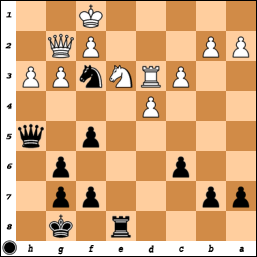
Chess puzzle #35: only move to win

Last weekend I played in the Malmö Open. I was pleased with my result. The strange thing is that I scored most of my points out of very difficult situations. In three games I was objectively lost. But tenacious defence saved the day for me.

The diagram position is not one of these games. Although I had to defend myself again. White attacked fiercely and finally invested a piece in order to keep the attack going. But to no avail. I gained the upper hand.

See the diagram position after 22. Bb6. White came with one more problematic move. Black is winning, but he has to find the (only) correct move. Do you see it? I did and went on to win the game! Solution…

Important endgame rule

One of the most important endgame rules is ‘do not rush’! See the diagram. 

I found this position with Chess Club Live. It says ‘white to move’. I don’t know why, but I had a funny feeling and checked the position in Megabase. 

This position was reached in a game from Anand against Comp Genius in de PCA/Intel GP London Rapid 1994. And my hunch was correct. There is something strange with this puzzle. It was not white to move in this position, but black! Does it make a difference?Read More »

How strong were the old masters?

It is difficult to say how strong these players were. You can’t compare them with modern grandmasters. The modern grandmaster stands on the shoulders of these giants of the past. In the old times a lot of stuff needed to be invented. Steinitz himself was one of the first grandmasters who formulated basic chess principles.

These principles, which favored a more cautious and positional style, were not to every-bodies liking. Most of the (top) players in that era were still stuck in the Romantic way of playing chess. This meant:

Go for the attack and try to beat you opponent with great combinations.

Defense seemed not very important. Only a coward plays defensive moves! Here you have an example.Read More »

Self destruction

The World Cup final between Svidler and Karjakin was a comedy of errors. We can have lots of fun when the big boys blunder. It’s also very easy to criticize them for their bad moves.

Of course it’s very convenient when we are sitting behind our computer and get some help from Fritz, Houdini or Komodo (of course 9.2!).

But what happens when we are sitting behind the board and smell the sweat from our opponents? Very likely we fare far more worse.Read More »

It is not a grandmaster’s duty to entertain the crowd (or is it?)

Karjakin-SergeyIn de last round of Norway chess the leader, Veselin Topalov only needed a draw against runner up Vishy Anand to secure the first place.

Well that was exactly what he got. He played a very solid line in a Queens Gambit and went at some moment for a well known repetition. It was a great result for him.

But it was a bummer for all the chess fans. I was watching this game live through Playchess and was hoping, like all the other chess fans, for a fantastic last round fight for the first place. But as I can remember the whole thing was over within an hour. After this let down I had a brief discussion through the chat with grandmaster Daniel King. He was very clear and said something to the extend of:Read More »

Wish you luck?

This August I played a tournament in the Göteborg chess week. For me it was ages ago since I played a single Round Robin with nine other combatants.

There were a lot of ups and downs. In the end I shared third price with some others. Maybe not bad for a start, but I was not happy with the qualitiy of my play (or better to say ‘the lack off quality’). Far form it. 

One thing strikes me as odd. Before the start of the game it is of course normal to shake your opponents hands. Most of them said ‘I wish you luck!’ Luck? Wasn’t it Viktor Korchnoi who once wrote:Read More »

Distractions

Chess can be a very complicated game. This is no news. And sometimes we over complicate things without knowing it. We get distracted and don’t see what’s the leading motif in a position.

See the diagram. It is black’s turn. The position is quite messy. There are a lot of possibilities. Do you see the correct solution?

I found this problem on Chess Tempo (number 738). It’s from a game between Franz Jittenmeier and Ludger Grewe (2234) played in 1998. Black found the correct solution and won.

I want to sacrifice something, but what?

Chess puzzles can sometimes be…? Well eh, very puzzling.

The problem with these puzzles is that it is always something like ‘white to play and win’.

And winning most of the time means: you have to throw some material at your opponents mercy, preferably a queen or at least a rook.

Sorry, I was just joking. It doesn’t have to be the queen or a rook of course. Any piece or even pawn will do. As long as it is a sacrifice. The idea is clear:

A sacrifice seems to be the logic consequence of the statement ‘white (or black) to play and win’. Or is it?Read More »

King first

In the middle game the king is usually a weak piece that we try to hide in a save place. But when most of the pieces came of the board, suddenly the monarch springs to life.

The king can be a very dangerous attacker. The golden endgame rule is ‘king first’.

See the first diagram (I). This is of course a very simple endgame, we should all know how to win.

A terrible mistake would be to move the pawn first. In that case the black king simply stands in front of the pawn and white can’t make any progress. The correct way of course is to first move the king up the board and to get hold of the important squares in front of the pawn. 

Of course this is a very simple situation. The chances that we get this endgame on the board are very slim. But these simple examples are the building blocks for more complicated situations.Read More »