Wish you luck?

This August I played a tournament in the Göteborg chess week. For me it was ages ago since I played a single Round Robin with nine other combatants.

There were a lot of ups and downs. In the end I shared third price with some others. Maybe not bad for a start, but I was not happy with the qualitiy of my play (or better to say ‘the lack off quality’). Far form it. 

One thing strikes me as odd. Before the start of the game it is of course normal to shake your opponents hands. Most of them said ‘I wish you luck!’ Luck? Wasn’t it Viktor Korchnoi who once wrote:Read More »

Distractions

Chess can be a very complicated game. This is no news. And sometimes we over complicate things without knowing it. We get distracted and don’t see what’s the leading motif in a position.

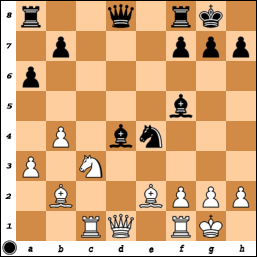
See the diagram. It is black’s turn. The position is quite messy. There are a lot of possibilities. Do you see the correct solution?

I found this problem on Chess Tempo (number 738). It’s from a game between Franz Jittenmeier and Ludger Grewe (2234) played in 1998. Black found the correct solution and won.

I want to sacrifice something, but what?

Chess puzzles can sometimes be…? Well eh, very puzzling.

The problem with these puzzles is that it is always something like ‘white to play and win’.

And winning most of the time means: you have to throw some material at your opponents mercy, preferably a queen or at least a rook.

Sorry, I was just joking. It doesn’t have to be the queen or a rook of course. Any piece or even pawn will do. As long as it is a sacrifice. The idea is clear:

A sacrifice seems to be the logic consequence of the statement ‘white (or black) to play and win’. Or is it?Read More »

King first

In the middle game the king is usually a weak piece that we try to hide in a save place. But when most of the pieces came of the board, suddenly the monarch springs to life.

The king can be a very dangerous attacker. The golden endgame rule is ‘king first’.

See the first diagram (I). This is of course a very simple endgame, we should all know how to win.

A terrible mistake would be to move the pawn first. In that case the black king simply stands in front of the pawn and white can’t make any progress. The correct way of course is to first move the king up the board and to get hold of the important squares in front of the pawn. 

Of course this is a very simple situation. The chances that we get this endgame on the board are very slim. But these simple examples are the building blocks for more complicated situations.Read More »

Horrific mistake

The Norway Chess tournament is until now (after round 5) a very exciting tournament with lots of fighting chess and some spectacular upsets.

Who would have thought that Magnus Carlsen would be in the bottom half of the standings with a meager 1½ points after five rounds with still four rounds to go?

Magnus is joined in the lowest ranks by his fellow countryman Ludvig Hammer. That is not surprising because Ludvig is by far the lowest rated player (2677) of the line up. But he is of course still a very strong player.

See diagram. Hammer and Topalev reached this position after an exciting game. The position in the diagram should be a draw. White has two pawns for the piece.

Converting in the right moment to an endgame with the bishop and some pawns would yield a draw. And even when all the pawns disappear from the board white still has hope for a draw because the rook + bishop versus rook ending is, except for some positions, also a draw.

Although in that case black would definitely have practical chances. Unfortunetely even strong grandmasters sometimes make horrific mistakes in the endgame. As usual there is a big difference between ‘should be a draw’ and ‘is a draw’. 

Bad evaluation leads to a comedy of errors

Is solving tactical puzzles the road to success in chess? Some people are inclined to say:

‘Yes of course. On club level almost all games are decided by tactical errors!’

So we need not bother about strategy? Or trying to evaluate postions in the correct way?

Well the answer is obvious: of course not! The correct evaluation of a position is mostly the deciding factor in chess. The majority of the positions do not contain any tactics and you do not need the calculate very deeply. Chess is al about thinking of the correct plans. To do this in the proper way, you need to evaluate positions correctly. Bad evaluations lead to bad plans. And in my case: lead to disaster.Read More »

Chess puzzle #23: tricky little move

http://www.viewchess.com/cbreader/2015/6/6/Game17430015.html

See the diagram on the right. What do you think: who is better?

The answer seems quite obvious. Although the pawn structures are almost identical, black has the active pieces. You might also say ‘the white king is missing his natural defender’ (a knight on f3).

But black’s advantage seems short lived. White is ready to exchange these active pieces and then the combatants can bring their game to a peaceful end and go to the bar. Or is there a way for black to exploit his advantage?

Here you will find the solution to this chess puzzle…

Endgame magic

You don’t hear anything new when I tell you that Magnus Carlsen is a fantastic endgame player. He has a habit of winning his games from drawn or slightly better positions.

The diagram position is from his game with white against Shirov. Shirov is well known for his fantastic attacking style. But in this position it’s is clear he has to defend.

Maybe that was not his cup of tea? Shirov played 1. – Bg7? This is a mistake. He could have held the draw with 1. – Bb8 according to Krasenkow in Chessbase Magazine 125.

The question is: how did Magnus win? Solution…

With thanks to Dr. Karsten Müller – DVD Chess Endgames 14 – The Golden Guidlines of Endgame Play

Chess puzzle #28: the devil is in the detail

See the diagram on the right. White has serious problems. His bishop on f4 is attacked by the knight and with it the pawn on e5. To make matters worse, black has a well supported passed pawn on d4. So what to do?

White decided in favor of drastic measures and played 1. Be3. His idea is: if you take my pawn on e5, I will retaliate with the capture on d4. If this exchange would materialize, it is a certain draw.

The problem is: white overlooked a tiny detail. Do you see this ‘detail’?