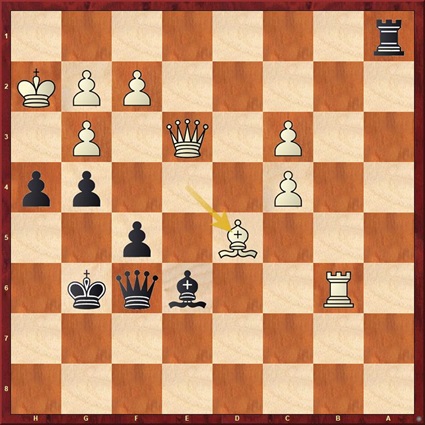
Things aren’t looking great for black due to the pin on the bishop by the rook. Is there any way out?
I found this exercise in the “friendly homework” from Killer Chess Training. This specific puzzle was on a sheet focused entirely on calculation. It features puzzles where you don’t know beforehand if the best line leads to a win; all sorts of outcomes are possible. That is actually a good thing, because in a real game, no one ever tells you:
“Pay attention now, you have a winning continuation!”
Consequently, you start looking at such a position differently. In fact, that is how it should be: first evaluate the position and weigh the pros and cons for both sides. Based on that, you select a few candidate moves. A good number is:
- 3 Candidates
This prevents what sometimes happens to me: getting “tunnel vision” by biting into a single line of play.
Let’s take a look, shall we?
When you examine the position, you immediately sense that tactics are the main theme here. What stands out instantly is the pin on the bishop on e6. Neither king is particularly safe. Should we talk about material? Well, fine: White is a pawn up, which could eventually become a dangerous passed pawn. But we’re nowhere near that stage yet. White’s pieces seem more active—or is appearances deceiving?
It is always a good idea to look at forcing moves first, in this specific order:
- Checks
- Captures
- Threats
Black has a check with 41… hxg3+. Honestly, this was the only move I thought made any sense. After other moves, such as 41… Qh8, White has 42. Qxe6+ and it’s curtains for Black.
In short: it seems Black has little choice. 41… hxg3+ is the move that will hopefully provide salvation from a dire situation. But then what? To be honest, it took me a little while to find the right follow-up. Here you will find an analysis…
What I find so impressive is that Black spotted 42… Kh5. After all, it was a blitz game. I usually can’t help myself (much like with Lichess puzzles) and have to check what happened previously. I’ve given 41. Bd5? a question mark. It’s the kind of move you easily make in a blitz game—it seems like it’s over immediately. However, it is often better to choose forcing lines, if possible.
The winning path for white was:
41. Bxf5+ Kxf5 42. Qf4+ Kg6 43. Qe4+ Bf5 44. Rxf6+ Kxf6 45. Qc6+
You have to see it all in a split second during a blitz game. Regardless, it resulted in a beautiful puzzle.
 Michel's Chess Blog