Chess puzzle #15 dead end?

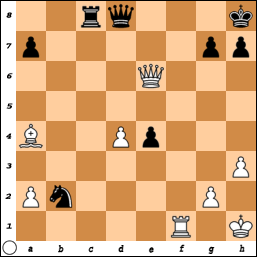
It seems that the black attack came to a dead end. That’s too bad, because he invested a whole rook in the adventure. The rook on a8 and the bishop on c8 are passive bystanders and of no use for the attack.

At first glance nothing works. For instance 1. … Nxe2+ is met by 2. Nxe2 Qxg4 3. Kh2 Bd7 4. Ng3 and white has the upper hand. Other moves seems to go nowhere either. So is it hopeless for black? On the contrary. He has a win. For you to find out how.

See the solution…

Go to the next chess puzzle…

Analyzing my own games #1

Some time ago I raised the question ‘what is your ideal game?’ I favored short and decisive games. Of course I wasn’t too serious. 

Winning a game without too many mistakes is my ideal. Preferably I dont give my opponent any chances and try to squeeze him. A game I played with white in our club championship comes close to this ideal. 

In the past I did not bother too much about analyzing my own games. I don’t know exactly why. Was I lazy? Or is it the feeling of disgust about the many mistakes I made (and still make)? Anyhow nowadays with the computer even players like me have the help of a ‘grandmaster’ and we patzers can try to make some sense out of what we have done and hopefully learn something from it.Read More »

Sweet chess victories (2)

In the first part of my blog about sweet chess victories I showed you two very short games. Today’s game is also very short. But maybe even more sweet. Why?

Firstly because I love short victories. Secondly I love them even more when my opponent doesn’t unnecessary drag things on.

But don’t you get a big smile on your face when your opponent resigns in a position that is actually not lost yet? Sorry, I am a bad person, but I can’t help  it: I get a big grin on my face. Everything was over within 13 moves!

Here you can play the whole game in the viewer. Let’s not bother about the first part of the game and have a closer look at the position in which black decided to call it quits (see the diagram). Black’s bishop is attacked. So he has to move it away. For instance 13. … Bg6 In that case white plays 14. Nxg6 and 15. e5 winning a piece. So that won’t work. How about 13. … Bg4? (now it get’s really funny!)

Read More »

Chess puzzle #13: tactics time

Tim Brennan received a lot of praise and some harsh criticism for his book ‘Tactics time’. The book contains 1001 chess tactics from players like you and me.

If you are looking for complicated and difficult tactics this book is not for you. This book is an anthology of the cheap and messy tricks of the everyday chess amateur. 

Almost all the tactics are very (very) simple. I played through the book on my Kindle (see the Kindle edition) and missed only a couple correct solutions.

The warning ‘this book could help you improve your chess game significantly’ seems a bit exaggerated. I think it might be true for lower rated players, say players under 1200. But that doesn’t mean the one can’t derive a lot of pleasure from the book and the tactics. I did and still do.

I subscribed to Tim’s newsletter (see his website) and receive his chess problems on a regular basis. It is always fun to have a look at it. To let you share in the fun I present you one of his problems. See the diagram. Black played 21. … Qb4 and white responded with 22. Bc2. Was this the best move, or was there a better possibility?

See the game and the solution… (with thanks to Tim Brennan’s newsletter).

Go to the next chess puzzle…

Sweet chess victories (1)

What’s you idea about the ideal chess game? I guess a lot of people will say: 

‘The ideal chess game is a long and difficult fight, full of nice moves and great ideas. After a tough and long struggle I managed to outsmart my opponent and won!’ 

I beg to differ. The ideal chess game is short and totally annihilates the opponent. 

Bobby Fischer once said: ‘Chess is war over the board. The object is to crush the opponent’s mind.’ I completely agree. Problem is that he was slightly more often on the side of the crusher than me. But, believe it or not, once and a while I also experience those glorious moments.Read More »

Chess puzzle #12: bad defense

At the lower level most of the games are won (or lost) by tactical errors. See for instance this position (first diagram). It is black to move. What should he play?
Let’s think about this position for a moment. White has an extra and well supported pawn on d6. His rook on a7 looks to be quite menacing. To add to blacks problems, his king is also in a vulnerable position. The direct threat is Qg7 mate. You don’t need to be a chess wizard to see this. Is this position hopeless?Read More »

The key to excel in chess

Some might say that calculation is one of the most important skills in chess. For sure it is an important skill. But there is at least one skill even more important.

If we think for a moment about it, it is completely obvious.

According to Jacob Aagaard in his book ‘Calculation’ (Grandmaster preparation)  the more important skill is seeing. Of course! You can calculate like a madman, but if you don’t have a clue about what to calculate it doesn’t make much sense. You need to have some idea about possible candidate moves.Read More »

Chess puzzle #11

How does white win after 1. Bd7 Rc7?
A cute problem

I found this puzzle on chess tempo (like a lot of others). I am not completely sure what was white’s last move. But I guess it was a move with the bishop.

So lets say from the diagram white played 1. Bd7. It seems to make sense because the bishop attacks the black rook and in doing so this poses a problem for black.

How should he respond? Certainly not the way he did with 1. … Rc7? After this move white has a nice finish. More tenacious would have been either 1. … Rb8 or 1. … Ra8. You see in the analysis why.

As it happens more often, I went for the wrong solution. After 1. Bd7 Rc7 I played a rather obvious move and missed a clever defense for black. See my remarks with white’s second move in the analysis*.

So the question is: how can white win?

Go to the next chess puzzle…

*With thanks to Mr. Houdini