 At first glance it seems black is in time to defend his king. White still found a way to destroy black’s defenses. Do you see how he did it? Solution…
Tag: chess puzzle
Chess puzzle #45: a though nut to crack
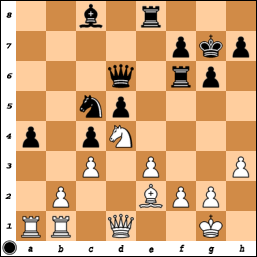 I have to confess that sometimes I spend quite a lot of time at chess puzzles. I can’t stand it when I am unable to find the correct solution.
When I make a mistake, which happens still too often, I can get very annoyed with myself.
Most of these mistakes occur when I find the solution rather quickly. Then get overconfident and don’t check very well and make stupid blunders on the second or third move in the combination. On the other hand, when I can’t find the correct solution, I keep on trying.
I follow my hunch and calculate the variations over and over again. That doesn’t work either (of course). One might raise the question: do you trust your own calculation yes or no? Seemingly not.Read More »
Chess puzzle #44: it is not what you might think
 I found this one from the chessbase website (first round report by Albert Silver). This position is from the game between Sam Shankland (USA) and Joan Fernandez Lopez (Andorra) after black’s last move 15. – Qb6? White can get a winning position. But how?
The obvious 16. b5 doesn’t work. What will? It took me a while to figure this one out, and of course I didn’t see all the variations. But at least I found the wining move. 🙂 Solution…
Chess puzzle #43: tricky move
 By the first looks of it black is in big trouble. He is two pawns dawn and his pieces are very loose.
Is there a way out of this quandary? Well there is. It is a very glorious one. Do you see how? Solution…
Source: problem #166673 ChessTempo
Chess puzzle #41: Being greedy?
 White just played 38. Qxf7 and left his rook on d1 en prise. It seems like a piece of cake for black to win the game. When you are hungry, indulge yourself with the food that is been offered.
Or not? Solution…
Chess puzzle #39: tricky stuff
 The tactical puzzles on ChessTempo are more difficult then on some other websites. They are taken from real chess games.
The solution is often a bit messy and not allways straightforward. Many times there is some sort of sting. And you guessed it right: I fall right into the trap. 😦
White just played 1. Kg4-f5. The threat is obvious: if white gets the chance to play Ke6 or Kg6 he threatens mate (Rf7#). This makes the conversion off f3-pawn into a queen a bit complicated. But it is the only way to win the game. Therefore let’s play 1. – f2 White answers 2. Kd3. The question is: how can black not only save the game but win it? See the solution…
Chess puzzle #38: too deep for a patzer
 Does it ever happen to you? I mean you look for a position almost endlessly, but still you can’t find the correct moves. It is not the first time this happened to me and I am afraid it won’t be the last time either. See the diagram.
White was already facing a lot of problems. But with 30. f4?? he turned a bad position in a losing one. How can black obtain a winning advantage? Solution…
PS. I failed to find the correct solution 😦
I found this puzzle on ChessTempo
Chess puzzle #35: watch out!

This position occurred after white played 17. Qf4 in the game Levon Aronian – Hikaru Nakamura (Candidates 2016, round 6).
Why is 17. – Nh5 a terrible move? Solution…
PS. Of course Nakamura played a much better move, but in the end he lost the game after 86 moves.
Chess puzzle 34: a big let down
 Yesterday was an important day for my team (Manhem III). With a win in our match against Säffle SK we would be the victor of our group (Allsvenskan div II – 5).
But it was not to be. Personally I feel responsable because I messed up against my opponent and therefore the match ended in a very disappointing 4-4.
Before the game I told one off my team mates about my game plan: ‘I will play it very safe, just do some moves and hopefully he will make a mistake and I will punish him for it.’ This plan turned out to be very effective. That is: up to some point.
I gradually gained the upper hand after a dull start in the game. We arrived at move 20. White has the better pawn structure, a good versus bad bishop and he pins black down to the defense of c6. Moreover white has a ‘tiny’ threat. Black didn’t see it and played 20. – Qg7?? How can white take advantage of this mistake? Solution…
I did see (and play) the combination. But very soon after this I missed some better moves and finally the game petered out in a draw. The first stage of my plan was a big success. The second stage however was big let down with dire consequences for my team. 😦
Can the white king escape?
 White threatens to mate the black king. But there is a problem. The black queen is checking the white king.
Your task is obvious: try to escape the female’s harassment. 🙂
I found this chess puzzle on chesstempo.com (puzzle 55657). To the game…
 Michel's Chess Blog