Sweet chess victories (1)

What’s you idea about the ideal chess game? I guess a lot of people will say: 

‘The ideal chess game is a long and difficult fight, full of nice moves and great ideas. After a tough and long struggle I managed to outsmart my opponent and won!’ 

I beg to differ. The ideal chess game is short and totally annihilates the opponent. 

Bobby Fischer once said: ‘Chess is war over the board. The object is to crush the opponent’s mind.’ I completely agree. Problem is that he was slightly more often on the side of the crusher than me. But, believe it or not, once and a while I also experience those glorious moments.Read More »

Chess puzzle #12: bad defense

At the lower level most of the games are won (or lost) by tactical errors. See for instance this position (first diagram). It is black to move. What should he play?
Let’s think about this position for a moment. White has an extra and well supported pawn on d6. His rook on a7 looks to be quite menacing. To add to blacks problems, his king is also in a vulnerable position. The direct threat is Qg7 mate. You don’t need to be a chess wizard to see this. Is this position hopeless?Read More »

The key to excel in chess

Some might say that calculation is one of the most important skills in chess. For sure it is an important skill. But there is at least one skill even more important.

If we think for a moment about it, it is completely obvious.

According to Jacob Aagaard in his book ‘Calculation’ (Grandmaster preparation)  the more important skill is seeing. Of course! You can calculate like a madman, but if you don’t have a clue about what to calculate it doesn’t make much sense. You need to have some idea about possible candidate moves.Read More »

Chess puzzle #11

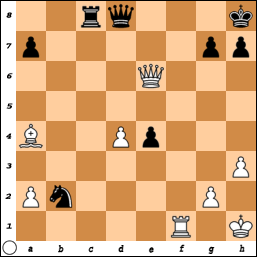
How does white win after 1. Bd7 Rc7?
A cute problem

I found this puzzle on chess tempo (like a lot of others). I am not completely sure what was white’s last move. But I guess it was a move with the bishop.

So lets say from the diagram white played 1. Bd7. It seems to make sense because the bishop attacks the black rook and in doing so this poses a problem for black.

How should he respond? Certainly not the way he did with 1. … Rc7? After this move white has a nice finish. More tenacious would have been either 1. … Rb8 or 1. … Ra8. You see in the analysis why.

As it happens more often, I went for the wrong solution. After 1. Bd7 Rc7 I played a rather obvious move and missed a clever defense for black. See my remarks with white’s second move in the analysis*.

So the question is: how can white win?

Go to the next chess puzzle…

*With thanks to Mr. Houdini

If only we would have a crystal ball in chess…?!

They say: ‘If you know what’s is going to happen on beforehand, you can travel around the world with a dime in your pocket!’ Or, here in Sweden they might talk about a couple of öres in your pocket. 

This idea is equally valid for chess. If you know what’s the position you are striving for, life gets a lot more easy.

See the diagram. Please do not move the pieces on your chess board and work it first out in your mind.Read More »