Chess puzzle #13: tactics time

Tim Brennan received a lot of praise and some harsh criticism for his book ‘Tactics time’. The book contains 1001 chess tactics from players like you and me.

If you are looking for complicated and difficult tactics this book is not for you. This book is an anthology of the cheap and messy tricks of the everyday chess amateur. 

Almost all the tactics are very (very) simple. I played through the book on my Kindle (see the Kindle edition) and missed only a couple correct solutions.

The warning ‘this book could help you improve your chess game significantly’ seems a bit exaggerated. I think it might be true for lower rated players, say players under 1200. But that doesn’t mean the one can’t derive a lot of pleasure from the book and the tactics. I did and still do.

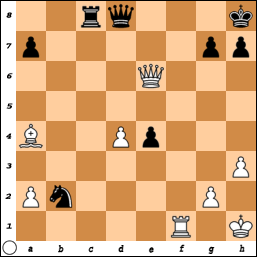
I subscribed to Tim’s newsletter (see his website) and receive his chess problems on a regular basis. It is always fun to have a look at it. To let you share in the fun I present you one of his problems. See the diagram. Black played 21. … Qb4 and white responded with 22. Bc2. Was this the best move, or was there a better possibility?

See the game and the solution… (with thanks to Tim Brennan’s newsletter).
Go to the next chess puzzle…

Chess puzzle #11

How does white win after 1. Bd7 Rc7?
A cute problem

I found this puzzle on chess tempo (like a lot of others). I am not completely sure what was white’s last move. But I guess it was a move with the bishop.

So lets say from the diagram white played 1. Bd7. It seems to make sense because the bishop attacks the black rook and in doing so this poses a problem for black.

How should he respond? Certainly not the way he did with 1. … Rc7? After this move white has a nice finish. More tenacious would have been either 1. … Rb8 or 1. … Ra8. You see in the analysis why.

As it happens more often, I went for the wrong solution. After 1. Bd7 Rc7 I played a rather obvious move and missed a clever defense for black. See my remarks with white’s second move in the analysis*.

So the question is: how can white win?

Go to the next chess puzzle…

*With thanks to Mr. Houdini

If only we would have a crystal ball in chess…?!

They say: ‘If you know what’s is going to happen on beforehand, you can travel around the world with a dime in your pocket!’ Or, here in Sweden they might talk about a couple of öres in your pocket. 

This idea is equally valid for chess. If you know what’s the position you are striving for, life gets a lot more easy.

See the diagram. Please do not move the pieces on your chess board and work it first out in your mind.Read More »

Another instructive endgame

We can learn a lot from endgame studies. Studies show a concept in it’s purest form.

The idea is that all the pieces on the board have a certain function. There is no unnecessary clutter which disturbs the concept.

What I like about endgame studies is that the positions might have arisen from real games in contrast to some compositions where you have to mate in a couple of moves. These compositions often look a bit artificial and couldn’t have evolved from a real game. Therefore I am not very fond of them. Of course this is a matter of taste.

I do like positions that pose a tricky ‘clean problem’. See the diagram. It is white to move. Can he win? If so, how?

See solution…

Read More »